Wednesday, May 13, 2015

Use of CME (Continuing Medical Education) to impact self-reported changes in the evaluation and management of anaemia in geriatric patients: An important topic for those of us with CLL (chronic lymphocytic leukemia)

Honestly, most of my fellow family doctors (FP) know very little hematology. This may be even more true of other primary care providers.

The ABFM board exams for family doctors dedicated a whopping 1% of all the questions to hematology- that is for everything from a simple iron deficiency anemia to a life threatening acute leukemia. Not much incentive to become expert.

As one of the few FP who lives and breathe heme with a deep and abiding personal stake in making sure that all things blood related are done right, and also as doctor with a long background in teaching, in fact a masters of science degree in Medical Education (all my initials are MDCM FCFP, DABFP, MS Ed), this publication on teaching my colleagues about the importance of anemia in the elderly and all the work that lead up to it definitely was a topic in my wheelhouse.

I was lucky to be involved in all ages of this effort: helped with the content development and served as faculty for all the live presentations to thousands of primary care providers across the country and worked on the very cool mobile app: Anemia Algorithm. Click here for the iPhone and here for the Android downloads (>15,000 total downloads). Finally I co-authored what culimated in the actual peer reviewed publication

The take away message of all our educational effort is that anemia (or if you prefer the British: anaemia) is not a normal part of aging, shouldn't be ignored and is often related to bone marrow issues that can be helped by a hematologist. 

Sadly, MDS (myelodysplastic syndrome) is too often missed by my fellow doctors. MDS are a group of bone marrow disorders in which the bone marrow is dysfunctional, cancerous, and does not produce adequate healthy blood cells resulting in either anemia or infections or bleeding problems or in more difficult cases,  dangerous combination of all three, depending on what hematopoietic stem cell line or lines are effected. This is an increasingly real and common concern for us CLL patients as we live longer, especially those of us who have had chemotherapy. Past history of chemotherapy is a long recognized risk factor for developing MDS. Please take a listen to this ASH 2012 prior post on CLL and MDS from one of my co-authors, Dr. David Steensma who is a recognized world expert on MDS and geriatric anemia. My other co-authors are Jill Hays and Kathy Farmer with whom I worked at Primary Care Network on CME, and Betsy Dennison who besides doing CME and patient education, works with the CLL Society. I am lucky to be part of such a fine team of researchers and educators.

We wanted to measure if we made a difference through continuing medical education in patients' lives, and looks like we did. That is the subject of our publication.

Subsequently, I have stepped away from much of what I do in non-CLL related medical education to be able to volunteer more of my time to the nonprofit CLL Society, but I wanted to share some of the past work that I have done to educate my fellow doctors over the past several years. I am very proud of these educational endeavors and they clearly inform all that I do on the blog and even more so now on our new website, CLLSociety.org. The new website is dedicated to educational efforts that move the bar higher by first surveying and assessing what is needed in the CLL community, teaching to those needs and following up to see if we made impact.

As a doctor, a patient and an educator, I and the rest of the CLL Society team try to reach beyond journalism to education, support, research, and advocacy, not just posting pleasant videos that report good news, but digging to point out the good and bad that might have serious treatment implications for us CLL patients. We have an vision: smart patients get smart care.

Labels: , , , , , ,

Monday, May 20, 2013

Personal Travels


With ASCO (AmericanSociety of Clinical Oncology) and EHA (European Hematology Association) upcoming, a significant backlog of abstracts to review, promised synopsis of critical issues, important editorials, and still some videos from ASH, I am going to grab this moment at the airport in Orlando to update my crazy spring.

First the biggest most important news:

My oldest daughter gave birth this weekend to our second beautiful granddaughter. Mother and baby are doing great (if you don't consider the sleep deprivation), and I am flying to Alameda to meet the newest member of our happy growing family. I can’t wait to hold her and smell her and kiss her.

Sydney Lilah

It is being alive for moments such as this that remind me why I fought so hard to travel across the country a year ago leaving the California sunshine for an Ohio winter, uprooting my wife and myself for months, and risking a new unproven therapy to knock back my CLL and ITP. But my calculated gamble has been an unmitigated success, offering me chances to see so much more than I could have dreamed possible. And no sight will be sweeter than my new grandchild.

Now that baby has safely arrived after a very quick and natural labor and delivery, my schedule is a little more solid.

This frantic spurt of travel started at the end of April with my trip to Columbus, Ohio for my treatment. I stayed a few extra days due to scheduled CT scans, an opportunity to tour of the new hospital and Dr. Byrd’s wonderful lab (the highlight was meeting the bright and enthusiastic PHDs, MDs, and other lab staff), meals with Dr. Byrd and other friends, new and old, and an amazing Mark Rothko exhibit at the Columbus art museum.

Rothko

When back home, I had time to catch a hockey game (Go Kings Go) where the Kings beat St Louis in the Stanley Cup playoffs, before driving up to the Bay area to help my then expectant daughter and son-in-law with the toddler. That didn’t stop me from flying to Vancouver, Canada for a few wonderful days of a west coast all boys high school reunion (UTS or University of Toronto Schools) that included kayaking in Deep Cove, a gondola ride to the snow and the grizzly bears at the top of Grouse Mountain, and poignant memories.

Deep Cove, British Columbia

Now I am writing this post from a plane leaving Orlando where I attended a two day primary care medical conference.

Once back in the bay area, I will be driving back to Orange County for a day or two, then onto San Diego for one day for more learning.

Before the next week is over, and after spending time at the office, getting trained on a new EHR (electronic health record) module, and visiting the infusion lab for my life saving IVIG and a routine check-up with my local CLL doc, Dr. Sharma, I will be leaving for five nights in Chicago to cover ASCO with Andrew Schorr and Patient Power. So far Drs. Byrd and Wierda are aboard for interviews and several other familiar faces are very likely. I will also be interviewing experts on other hematological malignancies and on some solid tumors for Patient Power.

Only two days after ASCO, things get real crazy. I will be driving up to Santa Clara to lecture with Dr. Steven Coutre out of Stanford on anemia and MDS (myelodysplastic syndrome), a too common complication of CLL and its treatment. From there, just hours after I finish, I drive to SFO to fly to Stockholm for only three days to share my experience with ibrutinib from a patient’s perspective just before the EHA meeting (European Hematology Association), then rush back to the bay area the day before I leave for Chicago to see my younger daughter, just back from her delayed honeymoon in Spain and Morocco.

After another brief visit with my daughter, son-in-law and the grandkids in Alameda, the drive to SoCal gets me home in time for more doctors’ visits, clinic hours, a local CLL support group, seeing my son Ben off to Stonehenge for the summer solstice with the Druids, all followed by a two days car trip to La Jolla for more medical education conference, this time on heart failure organized by UCSD.

A week earlier, my son, Will is flying to Israel for 10 days, and I hope to arrange a meeting up with my bone marrow donor.

The next weekend I am in Baltimore for more med. ed., and the extra bonus of catching the Max Weber exhibit at the Baltimore Museum of Art.

This is the last year of my CME cycles in Canada and the USA, and I must squeeze in a lot of hours to meet my requirements. Now I have to overload my credits to catch up before the end of June. Poor planning and other priorities lead to this crisscrossing of the country.

July 3, I have been ask to lead a CLL support group for UCSD on their campus in San Diego.

In between, I have scheduling and planning teleconferences and the Stanley Cup Playoffs.

No more travel is scheduled for July until I need to be back in Columbus, Ohio again in the third week, and I am so looking forward to not leaving home for a few weeks.

This frenetic pace is not sustainable or healthy. I nap often at the hotels and on the planes. I wear an N95 mask and gobs of hand sanitizer. I treat myself to the best vegan meals I can find on the road ( which is not saying much) and I always try to see more of the town that I am visiting than the hotel lobby. In Orlando, I hiked though a lush swamp with catfish and egrets and Spanish moss that was just minutes from the silly shopping malls and alligator miniature golf courses near my hotel. No amusement parks for this traveler.

Shingle Trail, Orlando

Then I took a long nap.

I bring my comfort foods (organic raw nuts and fine Japanese green tea), meet old friends, do work that I love, and have a rare opportunity to make a small but meaningful difference in the world.

This schedule was an extraordinary confluence of opportunities and my inability to say no to spread the word about how cancer treatment is changing. I admit there is desperation to all this journeying, but I know my time is limited and I want every moment to matter.

If I was more at peace, perhaps I could sense the gravity and power found in standing still, like a mountain, like a master, but I am still a breezy soul.

Labels: , , , , , ,

Tuesday, January 29, 2013

Traveling: The Good and the Bad

Less than a week ago I was on the western or Atlantic coast of Ireland with a plane to catch across drive-on-the-left-side whole of the snow covered island in Dublin on the Irish Sea. 

Tomorrow I am off for a medical educational conference in San Francisco. I had hoped to stay with my daughter and son-in-law and granddaughter in Oakland, but the toddler developed a fever and cough last night, so I am taking the BART from the Oakland airport to a Marriott near the Moscone convention center.

I leave the conference early on Friday, flying home to change clothes and freshen up so that I can drive to San Diego to give a lecture for UCSD the next day on heart failure and sleep disordered breathing to a group of cardiologists.

Back home late on Superbowl Sunday (whose playing?), before I leave balmy Newport Beach on the Monday for the sub-freezing temperatures of Columbus Ohio where on the next day, I will have both a bone marrow biopsy and an interview by OSU on why I believe in enrolling in clinical trials at the "James".  Not sure of the timing is so smart on that.

After flying home, a week later I fly across country again, this time to NYC for the 17th Annual International Congress on Hematologic Malignancies – Focus on Leukemias, Lymphomas, and Myeloma where I am trying to train myself to be more fluent in helping others with blood cancers other than CLL.

On my way home from Manhattan, I must stop for a few days in Springfield, Missouri for more medical education related business. On this multi-legged trip, I will be gone a total of 8 days.

One week later finds me in the nation's capital for a few nights speaking for the National Sleep Foundation on the "sleepy patient" at their big annual Sleep Health and Safety meeting.

Then finally by the end of the first week of March, I will be home to stay for almost a full month before I hit the road again.

In between all this scurrying about, I am being infused with IVIG, consulting my numerous doctors, being consulted by my patients, preparing all these lectures I must give and generally just living my life.

The frequency and depth of my blog posts can suffer, especially when I have extensive patient care and writing responsibilities.

But it is a privilege to get to see this much of the country, to have these chances to teach and learn and to meet and greet new and old friends. And I am so lucky to be well enough to travel. That wasn't always the case, so I don't take these trips for granted. Today I am at the cancer center for my IVIG and my CBC is near normal with a Hgb of 13.9, an ALC of 1.1 and a platelets count of 398. That's good to go.

And some travel is just pure pleasure. So while I still have a glow from our wonderful 8 day trip to Ireland, let me post some pictures in no particular to share a sense of the magic. What you won't get in the photos and the short video is the bone chilling cold of the winter rain and snow and the more than the compensatory heart felt warmth of the kind and proud Irish people we met.


Falconary with Harris Hawks at Ashford Castle 


Kylemore Abbey in Connemara


Back of Ashford Castle and Hotel where we stayed


Interior of the medieval Bunratty Castle


Village road in Bunratty


Cliffs of Moher in the bitter cold


Neolithic Poulnabrone Dolmen in the strange burren


Dromoland Castle, another one of our amazing hotels


View of Dromoland Castle from golf course (played year round)


Dirty Nelly's in Bunratty where my wife sat in on the "trad" music. She ate Galway Bay fresh oysters and I enjoyed a Guinness


Kilronan Castle and Hotel where we also stayed in the north


Neolithic carvings at Newgrange over 5200 years old (much older than Stonehenge and the Pyramids of Giza- Imagine standing inside a building built more that five millennia ago )

Labels: , ,

Wednesday, October 31, 2012

So much to share: All of it good.


Fall colors in Columbus, Ohio

Let me explain some of the reasons there are long gaps in my writing.

I am off to Detroit on my own tomorrow to lecture on myelodysplastic syndrome. It will be the 8th different city I have visited in 6 weeks, not including stops at airports and a second trip to Columbus. My agenda still has trips to Columbus x 2, Oakland, Sunnyvale, Chicago, and Atlanta.  Most will be taken as a lone road warrior, all before the end of the year. There is even a small chance of another trip for CME, maybe to NYC in December. Thank goodness that the last lecture on CLL to primary care that I am giving this year is in Anaheim, just a short drive away. January and February look almost as crazy. Medical education work in San Francisco, La Jolla, Springfield, MO, and Washington, DC, and pleasure trips to Ireland and Costa Rica. I am glad to be well enough to do all this traveling.

When I am in town, I am busy seeing patients and doctors and family.

I am left doing much of my reading and writing on planes and in airport these days. Thank goodness for my MACBOOK AIR, though the solid state hard drive is getting pretty full.

Let me bring you up to date by starting with my trip almost two weeks ago to OSU for my ibrutinib trial Clinical Trial NCT01217749.

I could not get out of the CT scans without risking losing my spot in the trial. That made the decision easy.

I refuse the dental x-rays, the body scanners at the airport, and whatever I can, but in one day I have essential five sets of CT scans. It is a small price for access to ibrutinib.

If my biggest complaint is the excessive CT scans and travel needed for the trial, I must be doing rather well.

My news from Ohio and the ibrutinib trial was super.

On the too many CT scans Oct 19,  they found no enlarged cervical nodes. Nothing at all. Nada. Rien du tout.  This is a huge change for the better.

The largest axillary node had shrunk just a little to 2.1 x 1.3 cm and was the only node >1.3 to be found.

The chest remained free of adenopathy as is the usual case in CLL in general and me in particular.

The gut and pelvis is where I had had massive nodes before. The largest node, portal caval, (near the large vein draining the liver, a common site for cancer laden nodes), is still entirely too big at 4.4 x 0.9 cm but it had shrunk from 5.5 x 1.5 cm since June. That is about a 50% drop in area in 90 days. Still a ways to go, but that bad boy had started at 7.3 x 3.3 cm in March. It is less than 20% of the size it was when I started on the trial. One particularly nasty mesenteric node that was over 10 cms six months ago is now only 0.9 x 2.4. No wonder my tummy feels lighter.

And thankful, no surprises. No secondary cancers lurking in the kidneys or liver or lungs. Friends have not been so lucky as I have shared on prior posts with unwelcome findings on the scans.

Well, there is was actually one small surprise, not completely unexpected. My spleen is growing back. This is not of any clinical significant, as my ITP remains well controlled with cyclosporin and IVIG, but will need to be watched. More on that subject later.

Physical exam and blood pressure are all what you want them to be: boring.

Labs are normal except for a mild anemia.

I am hardly cured or even in a complete remission, but every single node has shrunk each time it has been imaged, and by any definition, I am in a deep partial remission.

Ibrutinib seems to be continuing to perform as it best publicity suggests it should for the majority of those in trials. It decreases the tumor burden at a slow and steady by shrinking the nodes where the cancer is most active and productive, and certainly in my case, most prominent. I never had very high lymphocyte counts, but had massive painful nodes. There is every reason to believe, based on those ahead of me in the study, that this painless cancer shrinkage and control should simply continue for who knows how long.

In three short months, my visit to OSU will include more CT scans and a bone marrow biopsy, then the OK to roll over into the continuation trial.

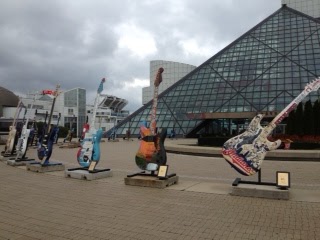
So to celebrate I stopped at the Rock and Roll Hall of Fame on my way home via Cleveland, and spent half my too short visit at the Beatles display. A splendid time was had by all. I highly recommend it.


Rock and Roll Hall of Fame, Cleveland. Ohio

More soon with the truly wonderful news and pictures from my daughter's, Heather, wedding last week in Chicago.

Life is good.

A great middle eastern meal with an important and kindly MDS expert and the amazing Diego Rivera mural and more at the Detroit Institute of Art await this weekend.

But honestly, I would rather be at home reading and writing and walking on the beach and eating organic raw food.

Labels: , , , , ,

Sunday, May 27, 2012

Las Vegas, Valley of Fire, CLL lecture


Arch at Valley of Fire State Park 50 miles outside of Las Vegas

Been in Las Vegas to lecture for continuing medical education (CME). Staying at the Vdara which is a non smoking hotel with no casino.

That part is good. I can even find organic raw and vegan food.

But Vegas is crazy and crowded with falling down drunk people. The traffic is ludicrous. The prices are incredible. The lights and noise are overwhelming. Last night it took 45 minutes to drive two blocks because Kaskade was DJing at the hotel next door. Don't tell me your don't know who Kaskae is? The short tight black club dresses that everyone and I mean everyone is wearing make the 60s mini skirt looks like a nun's habit.

I so feel that I don't belong here. Am I getting old or what?

But there is a lovely view from the 51st floor of the fountains at the Bellagio and the drives to the amazing red rock parks nearby has made the trip. I love the desert. So calm and quiet and austere.

By the end of June I will have lectured to well over a 1000 primary care providers on CLL and its emerging therapies.

My lecture here was focused on what a primary care provider needs to know about CLL to best care for his patients. I also want the audience to know how the future of CLL in particular, cancer  in general, and medicine universally is moving away from blunt therapies such as chemo and towards targeted treatment such as ibrutinib.

I was pleasantly surprised by the strong level of interest in the topic by healthcare professionals whose roles may often be more supportive in treating these patients.

I am continuing to do well on my ibrutinib- mild gut issues, but shrinking nodes.

Tomorrow I will be in Ohio meeting with some dear CLL friends who will driving in from the east.

Soon I will blog more on how I see ibrutinib fitting in the world of CLL therapy and will post an update after my Tuesday clinic visit.

Labels: , , , , ,

Wednesday, March 7, 2012

CLL EDUCATION FOR PRIMARY CARE PROVIDERS

Friends

Here is a link to the first of several CME activities that I put together out of the video recording of my interviews of Drs. Kipps, Pagel, and Wiestner at ASH, 2011. I am hoping to do the same for ASCO 2012 in Chicago if I can get the funding support. Any ideas?

Please go to http://www.primaryissues.org/ and select the CLL recognition link. You need to answer the pretest questions to get to the videos and text.

There is much more to come, but these are a lot of work. I am pleased with how the first one turned out. My son, Ben was the camera man and did the hard work of all the editing.

I am committed to teaching primary care providers about blood cancers, especially CLL. I believe they can play a critical and unique role in the patient's care.

On a personal note, I am back from my screening visit to OSU and will be flying back Saturday to Columbus Ohio to start my weekly ofatumumab x 8 then and only then to I get to start my PCI-32765. My counts remain good, but my nodes are definitely on a slow upward march, so it will be good to get into therapy.

Labels: , ,

Thursday, January 26, 2012

Dr Adrian Wiestner Speaking to Primary Care Providers about CLL

Many of you have seen this clip before.

I am reposting as it is the first in a series of interviews that when strung together should make the average primary care provider much more comfortable with the diagnosis and management of his or her CLL patient..

The reality is that many patients, especially CLL patients, who nearly always have enough time to learn about their disease before needing therapy are often more up to date on the latest than their primary care provider who may not see or recognize too many CLL patients.

I am trying to change that knowledge gap. This small pilot project will give you a sense of my other life in CME (continuing medical education) as a medical director. Primary Issues is the online journal for PCPs where I plan to publish these video snippets with the text and the questions to measure outcome that you see below.

I need your help first .

Tell me what you think works and what misses.

Tell me what I should be saying to your PCP.

Understand this clip is just the briefest opening to what is CLL. It is of course not the whole story. Drs Kipps, Pagel, and Wiestner will be talking more about diagnosis, symptoms, complications, treatment and the overall role of the local primary care provider in the patient's care.

I promise I won't post the same clip twice again, I just needed to start at the beginning.

Please email at bkoffmanmd@gmail.com or post your comment or suggestion. It will help me and may help others.

Because we are all in this together.

CLL Overview with Dr. Adrian Wiestner

PRE TEST QUESTION

Managing CLL is made difficult by the fact that:

1: It is the most rare of all adult chronic leukemia.

2: It usually presents in an aggressive fashion with B symptoms and white counts over 100,000 that need prompt attention.

3: It is nearly always asymptomatic, doesn’t progress, and any treatment other than reassurance should be avoided.

4: It may be very aggressive and symptomatic or it may be very indolent and asymptomatic.


Chronic Lymphocytic Leukemia or CLL is the most common adult leukemia in the United States, with approximately 15,000 new cases a year representing about 30% of all adult leukemia. The male to female ratio is 1.7: 1 and the average age at time of diagnosis is 70 years old, but it not unusual to find it in a 30 year old (Hernández JA, Land KJ, McKenna RW. Leukemias, myeloma, and other lymphoreticular neoplasms. Cancer 1995; 75:381). It is more common in Caucasians, and less common in Asia. These differences appear to be genetic as they persist when the ethnic population moves to America. Ashkenazi Jews may be at particularly higher risk (Leukemia. 1998 Oct;12(10):1612-7.Epidemiology and ethnic aspects of B cell chronic lymphocytic leukemia in Israel.Shvidel L, Shtarlid M, Klepfish A, Sigler E, Berrebi A).

What makes CLL so difficult for both doctor and patient alike is that about 25% of patients present with asymptomatic disease found incidentally on a routine blood count that may never need treatment, whereas up to 10% may present with rapidly climbing lymphocyte count and enlarging nodes associated with fevers, drenching night sweats, extreme fatigue and/or unexplained weight loss that demand immediate treatment. Others follow a course somewhere in between. CLL absolutely demands personalized care.

POST TEST QUESTION

Managing CLL is made difficult by the fact that:

1: It is the most rare of all adult chronic leukemia.

2: It usually presents in an aggressive fashion with B symptoms and white counts over 100,000 that need prompt attention.

3: It is nearly always asymptomatic, doesn’t progress, and any treatment other than reassurance should be avoided.

4: It may be very aggressive and symptomatic or it may be very indolent and asymptomatic. (CORRECT)


Labels: , ,

Thursday, August 19, 2010

Photo from my curly hair days

This picture was taken after my hair grew back and before my 1st haircut post transplant.

This is just a mock up for CME sponsored by PCE and PCN with whom I am proud to be associated. They are using my picture as a place holder in a trial to rework the web site. They have much better looking and famous speakers to populate their real home page, but I like my 15 minutes of fame.

If you want their real websites go to http://www.primarycarenet.org/ or http://www.primarycareed.com/ Their conferences are simply the best for primary care providers. Practical, patient oriented, balanced, and up to the minute.

I will be lecturing for PCE on anemia in the elderly and including MDS (myelodysplastic syndromes) with Dr Steensma from Mayo and now Harvard. My job will be to keep it real and practical in a complicated topic with which I hope never to have any personal experience. It is of particular interest to me that the drug that may revolutionize the treatment of MDS is the same new best friend for us with CLL, lenalidomide (Revlimid).

I am at the infusion center, patiently waiting for my IVIG and lab tests to get going. The usual spark plug, Ginger, who gets the process rolling is on vacation, so I still am able to easily type with two hands until the IV gets started.

Labels: , ,

Sunday, December 14, 2008

"Turn off your mind, relax and float downstream" The Beatles

More than anything, I need to stop everything, at least for a few hours. Reboot and the kick start my brain. Lots of foot to the mouth images.

Before tomorrow hits, I have medical records to summarize and collate for upcoming consults, expense reports to copy and total and fax for recent travels, and CME (continuing medical education) to document and  complete to keep my board certification active on both sides of the border.  I was behind in CME due a little thing called a transplant messing up my travel plans for the last half of this year. Now with my recent whirlwind of conferences I am over the bar. Rest assured this writer is certifiable, make that board certifiable in Canada and "the states".

Meanwhile pesky insurance companies (medical and disability and life) are writing carefully crafted letter demanding urgent and largely redundant paperwork from me and my doctors.

My writing sample and application for consultations of a different sort are overdue for the writer's conference in San Diego in February.  I can hear the consulting editor now: Not another disease of the month book please! All in all it gives me another chance to see how many more chainsaws I can juggled blindfolded.

Like I said, time to turn off my mind and reboot. This is not a healthy mindset. Instead I will head to the sand and the ocean. Life is beach.

Labels: , ,