Tuesday, August 9, 2016

Reflections on Risking a Safari in Kenya when Fighting CLL (chronic lymphocytic leukemia)

Was it a good idea to go on a photo safari all over Kenya?

The safest and maybe the smartest course is to stay put.

Or maybe risk a trip to the beach for the weekend.

Many fellow CLLers have asked about the trip wondering if it they too could take such a safari. Is it safe or is it foolhardy?

Consider the pre-trip facts:

It would take two full days with lay overs in Qatar, I would fly across 10 time zones to land in Nairobi, AKA Ni-robbery, a high crime city in Kenya, a country the State department says is dangerous to visit with a terrible shortage of good medical care and way too few doctors and supplies and then I would travel from there for seven hours or more on dangerous two lane highways or barely maintained one lane gravel road through shallow river beds and deep rocky pits in rumbling Land Cruisers with red dust flying and bones shaking in what is jokingly called an African massage crossing the equator to get to a tent camp in the middle of nowhere and then I would do the same road trips again and again.

When you have a compromised immune system and a blood cancer, is a trip such as this a clear sign of….
  • Craziness? Maybe.
  • Risk taking behavior?  Of course.
  • Saying no to cancer saying no to me? You bet.
  • A carefully calculated gamble that turned out amazingly well? Absolutely.

This was a fantastic trip and I loved everyday of it.

I felt safe and healthy and fully alive.

So here’s my advice to others.

If your doctors say OK, do it.

And don’t believe all that you read.

I still bought travel insurance that waived the pre-existing conditions included coverage for an emergency MEDI-VAC flight if I needed to get to a good hospital back home or in London.

With a proper safari company (we used the wonderful team from As You Like It Safaris whom I highly recommend) we were well cared for from the moment we stepped into the arrival lounge at the airport.

We were met at the airport and whisked away to the elegant colonial era Muthaiga Country Club for lunch. Nairobi traffic is infamous and street hawkers hang on to the car at every stop which are frequent and lengthy, but we never felt threatened.

Most western hotels in Nairobi have airport like security with barriers for the cars entering and x-rays machines and metal detectors.

I stayed away from salads and fresh juices but most fellow safarians ate everything and did fine. All my water was boiled or bottled (listen for the click), even for brushing my teeth. Food was great- mostly Indian for me, but it was easier to be vegan in Kenya than in Louisiana or most of Texas. 

I got all my shots. Unlike Tanzania, Kenya does not require a the live Yellow Fever vaccination that would have made the trip a non-starter.

I was up to date on typhoid (the shots, not the live oral form), tetanus, hepatitis A and B.

I brought antibiotics (Cipro and Zithromax and used none), GI meds (Pepto and Imodium-AD and used none of it), pain meds, ointments and creams, hand sanitizer, sunscreen, and a full extra week of my ibrutinib and all my other meds.

I had a note from my doctor listing all my meds.

Due to the time change, I switched to take my morning meds in the evening and vice versa to keep the intervals between doses on the travel days with the 10 hour time change. Ibrutinib only binds the BTK sites for about 24 hours and I didn't want to stretch that out.

I took Malarone with no side effects to protect against malaria, wore long pants and long sleeve shirts treated with permethrin, and used high dose DEET twice daily during game drives. I got a total of two mosquito bites in the whole two weeks. I woke a hat and a buff for the sun and the dust.

The tent camps in the bush were marvelous and often quite luxurious. Except for the mischievous monkeys that want to steal anything and everything, it was very safe. Power might be intermittent and run off a generator, but we are out in the savannah.

And the night sounds were loud, melodic and startling. I could have done without the scent from the hippo pool.

But where else would I get a Maasai warrior walking me to my tent to guard against the wondering hippos or a Samburu villager with a sling shot keeping away the monkeys and mongooses away from our food when we dined by the river watching the Nile crocodiles bask in the sun or the elephants cross the shallows?

Folks left I-Pads and expensive cameras lying out and returned to find them untouched hours later.

The Serena chain of hotels in the National Parks and Reserves were all first class- clean, beautifully designed with gorgeous views, good food and great service.

All the Kenyans we met were friendly and helpful. Guides/drivers can make or break the trip and ours were encyclopedic in their knowledge of the local flora and fauna and wise in the ways of keeping us safe and comfortable. And kind and generous.

The wildlife doesn’t disappoint. Seeing a lion stalk and kill a wildebeest or watching them mate (it is female initiated, very, very quick and oft repeated every 15 minutes or so for about 3 days ), or a leopard or cheetah mom with her cubs or an elephant family care for their young, on a gerenuk get up on its hind legs to sample some high up tasty leaves or more colorful birds than I can remember or giraffes spread their legs widely to reach down for a drink or vultures and Marabou stork fight over a carcass or flamingos turn the sky pink when they all take flight together or countless herds of zebras and gazelles and oryx and cape buffalo and impalas living together has made me never want to go to a zoo again.

All animals need lots of room and many need their families to live a normal life.

But the highlight of the trip had to be the wildebeest and zebra crossing of the Mara River as part of the great migration.

More on that in a later post.

And pictures to follow.

Labels: , , ,

Wednesday, July 20, 2016

Dr. Furman on genomic testing and MRD negativity in CLL (chronic lymphocytic leukemia)

I am going on radio silence and am writing this from the airport in Qatar so please don’t be upset or worried if I don’t respond to questions or comments.

Betsy Dennison, an oncology RN and NP who handles our website will be posting some interviews from ASH and EHA while I am gone. Today she put up this pretty cool one with Dr. Furman  that really explains the different types of genomic testing and the changing importance  of MRD-  in the era of new therapies.

I must admit for a world traveler, this trip to photo safari in Kenya has me worried. It is a long way aways and it is a long time gone in a poor and dangerous country  in some areas with all kinds of disease that are not a concern here

Once I am there, all should be well. I hear that at the tented safari camps, all is calm and secure if still noisy from all  the nearby animals.

Clothes are sprayed with permethrin, I have a ton of DEET and it is not mosquito season.  I will take Malarone. Kenya does not require a yellow fever vaccine  and risk is very very low and Typhoid can be given as a killed vaccine.  

I am staying away from salads and fruit drinks- that will be hard, and bringing a ton of emergency meds (cipro, immodium, Z-Pak, prednisone, pain meds, anti-histamines, suture kit, disinfectants, and an extra week of all my daily meds including my ibrutinib.)  Sunscreen, N95 masks and hand-sanitizer too.

And I won’t feed the lions, or monkeys or swim with the hippos.

I look forward to catching up when I return.

This is the first trip in years where CLL has not been at the top of the agenda, and where internet is iffy at best.

Stay strong.

We are all in this together.

Brian

Labels: , , ,

Sunday, February 28, 2016

Traveling Blues related to CLL (chronic lymphocytic leukemia)

Stairs to the beach at Torrey Pines State Nature Reserve

February may be an extra day longer this year, but that still doesn't justify my travel schedule.

I was in Charlotte, Tampa, and Atlanta this month to speak to patients and caregivers about the importance of a CLL support group. The meetings were successful beyond our highest expectations, and if the cards and the support line up, and I expect they will, we soon will be starting CLL specific support and education groups on the east coast with strong  local enthusiasm and support.

When I am on the plane, I wear my N95 mask and using prodigious amounts of hand sanitizer to preserve my health.

I was in cold and snowy Columbus at Ohio State for my CLL clinical trial (more on that in a later post). It is not easy to leave warm and sunny Socal for the snow.

I was in Dallas for just a few hours at the airport to meet others to discuss the changing nature of medical education for family doctors.

And I drove to San Diego twice. The first time was for a wonderful meeting with a fellow CLL patient who is doing important and worthy work to educate and counsel those fighting a major illness or dealign with a serious life event (much more on that later too).

The second trip (that gave us time to hike at the beautiful Torrey Pines State Nature Reserve on the way down) was to attend the two day international CLL Research Consortium (CRC) meeting with folks such as Drs. Kanti Rai and Bill Wierda and Neil Kay and Tom Kipps and John Gribben and Matt Davids and Mike Choi and Cathy Wu and Jeff Jones and Januario Castro and Jennifer Brown and Carlo Croce and Nick Chiorazzi and Philip Thompson and Jackie Barrientos and many many others. What a privilege to be there and to hear their ideas on new research directions and to be able to insert a patient's perspective.

Many of the trips saw me flying across the country for only a few hours before scurrying home.

All this time in planes and cars is crazy and unhealthy and expensive and inconvenient, and very very tiring, but I do it because when there are these opportunities to make an impact or learn something or forge a new alliance, if I can go, I will try to be there.

March sees me in Denver and Dallas, back to San Diego again to see Dr. Kipps, and a quick trip to the beach.

I will be speaking at the LLS Blood Cancer Conference in Anaheim on March 19. This is a great conference for patients and caregivers. Tanya Siddiqi from the City of Hope will be talking about CLL. Those who heard her at our City of Hope CLL Patient Forum in December know what a great  speaker she is and how deeply she understands CLL. Try to attend if you are in the area.

The CLL Society will again have a table there so please say hello. Last year's LLS Blood Cancer meeting was our "coming out party", and this year we get to brag about all that we have accomplished in our first year and our plans for 2106 as a non-profit.

Yes, it has been and will continue to be crazy with seven trips out of town in the month (and one I didn't include on January 27), but today, I have nothing except for some phone calls that I must do on my schedule.

I plan to enjoy my down time listening to the Beatles and some be-bop and then going for a long walk.
Sunset at Torrey Pines on our way to San Diego

Labels: , , , , , ,

Monday, June 29, 2015

The Trend is Our Friend: Living with Uncertainty with my CLL (chronic lymphocytic leukemia)

My lab test have shown a blip.

After a gradual but steady improvement in my tumor burden visit after visit at Ohio State University (OSU) during my last three years on ibrutinib (when I started it was then called PCI-32765), on my last visit my ALC (absolute lymphocyte count) rose the tiniest amount to about 2, but I didn't worry as it still was well within normal limits. It was just an unusual result for me. It hadn't been over 1.4 in a couple of years, now it was >2.

The rest of the CBC and the chemistry panel was all normal.

The next day back in California I was due for my IVIG and my repeat ALC was back down to around  1 again so I didn't think much of it. 

The fancy flow cytometry that checks for the small population of my clonal B cells, my CLL cells, is the test that really counts. That measures how many cancer cells that I still have and every test had shown fewer than the last. Both Dr. Byrd and I had predicted that already small number would continue to fall, but I would not yet be MRD negative.

What hubris!

When those results were not forthcoming in the weeks following my visit, I calmed my catastrophic flights of imaginations with reminders that when counts are too low, sometimes it hard to get an accurate result.

Then I got the news that I had a "small number of B cells" on the flow, within the expected variation seen from test to test. 

That is "doctor talk" for the fact that my count had bumped up a little, but the number was still within the expected margins of error of the test, or not significant different than the prior result. 

I still haven't seen my flow report nor do I know my absolute number. I will need to know that number at some point, but knowing it would make absolutely no difference today in what I do now, so I will try to be patient (not my best trait).

What I do know is that if the count had gone down, even just a little "within the expected margins of error" I would have been told and cheered on.

As we know that the only major group where we have seen a higher rate of relapse of their CLL on ibrutinib are previously treated patients with deletion 17p such as myself. They are the only group where < 1/2 are still progression free after less than 2 1/2 years. I have enjoyed being part of the happy minority on the Kaplan Meyer graphs.

But is this my personal start of a bad trend, the first stirrings of a tiny resistant clone that will only grow over time to become dominant? Is this the beginning of the end of my super duper run with ibrutinib?

Honestly I doubt it. 

Here's why I am honestly not worried.

A week later I received the wonderful news that my BTK and PLCG2 mutation test was negative and since nearly all CLL resistance to ibrutinib is related to a growing clone with either the BTK and PLCG2 mutation that prevents the ibrutinib from blocking signaling, odds are excellent that my lab result is nothing but a meaningless blip. Richter's Transformation (RT), the other common and more sinister cause of relapse on ibrutinib, tends to occur early in treatment and three years out is not early.  I don't have RT. No signs or symptoms.

So although I won't rest completely easy until I see my next flow cytometry results sometime after my next OSU clinic visit in August, odds are really with me on this one.

The trend is our friend, and as I have coached so many others, I now must heed my own advice: One lab test means nothing.

I will be traveling for a couple of weeks in Poland on a Jewish Heritage trip with my rabbi. One purpose of the trip is to forget all about CLL and our nonprofit CLL Society for a few days, but I will be busy in the evenings in Eastern Europe writing for the CLL Society website (some great stuff from the CLL Research Consortium or CRC Patient Empowerment and Education Meeting and from EHA coming soon) and more critically, for a peer reviewed medical journal on CLL due the beginning of August. 

I am alright with that crazy balancing act though I do worry what I will eat in Poland, not exactly a vegan's paradise.

Labels: , , , , , , , , , ,

Wednesday, May 27, 2015

Living With CLL (Chronic Lymphocytic Leukemia): My Personal Clinical Trial News and Travails from the James and My Take on IV versus Oral Therapies.


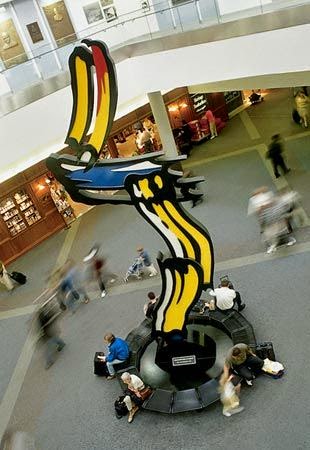
"Brushstrokes in Flight" by Roy Lichtenstein at CMH airport

If you want to skim through my long miserable travel story, and just get to the lab results and my reflections on all these goings-on, my feelings won’t be hurt.

Monday, May 25, 2015, I got out of bed around 5 AM after only 4 hours sleep in order to catch my early flight to Columbus via Dallas (DFW), so that I might arrive in Ohio (CMH) in time to spend some hours with a good friend over dinner.

All went well at the airport (breezed through security in 5 minutes) and with my first flight.

Little did I know that I would be spending time with news friends, my fellow travelers sitting on the tarmac for 3 hours the first time, and more than two hours the second time.

And I must have looked mighty strange during much of that hurrying up and waiting. Having somehow lost my N95 mask after the first flight, I wore the cloth eye mask that I had in my bag over my nose instead of using it for its true purpose of blocking out the light to allow sleep.

Torture by a million blows: 

First, after boarding the plane and a minute away from take off, comes the first 15 minute delay at the gate due to the rain that’s coming but not there yet, then another 30 minutes delay, and then more and more, then finally we are pushed out the gate as the ground crew are back in action now that the rain threat has passed, but when we get to our runway there are no longer any flight corridors to the north, so we wait and wait and wait again, then make the decision to make the long taxi to the other side of the airport for a take off on the still open longer southern route to our destination (FACT: DFW is bigger than the entire state of Rhode Island), only to wait again…. until we become too low on fuel to make it to Ohio, so back to the gate, where just before  things are looking as if we finally might get airborne, we next learn that our flight crew has just passed the “legal limit” of how long they can be at the controls, so we need a new pilot and first officer. More delays at deceptively optimistic 15-minute increments, until the final cancellation is not really announced, more just realized and we all march off the plane.

I am one of the lucky ones who left the long, long line at the unlucky gate and walked to the next open gate (a flight to NYC as I recall) where the helpful agent helped me grab one of the few remaining seats on the next flight out, originally scheduled for a departure about three and half hours after the first one.

I was OK with all this until the almost identical story started repeating itself on my second flight, right down to losing our crew as we were within minutes of departure.

Now I was starting to get panicky.

I was stuck at DFW. It was after 10PM and we had no crew. As a result of having no one in the cockpit, we, of course, had no air conditioning. No one could turn it on.

There weren’t even any flights available the next day that would get me to the clinic in time for an afternoon appointment. And I have my important IVIG infusion scheduled back in sunny California the day after. And the day after that, I’ll be off to Orlando, and the day after that, Chicago for ASCO. My dominoes were tightly lined up.

No clinical trial appointment at OSU would mean no more magic pills.

I was completely out of my ibrutinib, having stretched this clinic appointment to the maximum at 13 weeks. AND I had just read the ASCO abstract about increased relapses when we miss more than a week of pills. More on this critical subject later.

It got me thinking.

This cancer-controlled life is such a fragile construct and there are so many ways it can blow up. Let’s face it: Those of us with CLL that need treatment, especially in a clinical trial, especially in a clinical trial across the country, are high-maintenance and high-risk for something messing up.

Of course my dinner was canceled. And any food plans. No 7/24 vegan catering in Columbus.

But amazingly American Airlines did find a fresh first officer and about 45 minutes later, a new captain for my second flight.

That plane ride to Columbus ultimately left a little more than 8 hours later than planned and instead of arriving at 6:45 PM, I got in well after 2 AM. All the car rental stalls were closed. Got into bed at my friends’ house (without waking anyone up) around 3:15 AM and was up again at 6:45 AM for an 8 AM clinical appointment.

All of this with a lingering cold! And with less total sleep times in two days than total time on the tarmac.

But it all worked out.

And there were some unexpected surprises:

In Dallas, I was introduced to a wonderful 91-year-old women aviator, flight instructor and former WASP. At the request of her friends who discovered that we were on the same flight, I helped shepherd her through the same confusing mess that so many of were enduring. She was charming and full of great stories and she walked faster than I did.

When we arrived at CMH, she asked if I might help drive her home as we discovered she lived close to my friends’ home north of Columbus, so after some fumbling with the GPS in her new KIA parked in an offsite lot, I drove to my destination and she continued the less than 2 miles to her home.
At the clinic early the next morning, Dr. Byrd checked out my head cold and declared it was a head cold. No chest rattles or swollen nodes. No treatment.

My blood count was basically normal- borderline anemia, but all else was good including normal platelets. Blood chemistry was normal too, except for the usual low protein. That’s what happens when we don’t make immunoglobulins, so no surprise there

But I always seem to manage to find some cause for worry. My ALC (absolute lymphocyte count) was a very normal 2.48 but that is double what it has been over the last few years. It usually lingers around 1 or less. 

Why the jump up?

Could it be from my cold? You bet, but I still will be happier when I see that it is not the start of a trend.

(HAPPY UPDATE: ALC was 1.2 the next day back at my local infusion center at St. Jude Medical Center in Fullerton)

My small number of myelocytes probably also signifies nothing. You are not supposed to see any myelocytes in the peripheral blood

My LDH was just a tiny high too. 207 and normal tops out at 190. There are a million causes for that blip. Most are innocuous, but it can herald cancer resurgence when it climbs and climbs and climbs. Again it makes me more vigilant, but I know and I counsel others that the trend is your friend and will tell the tale, not one isolated and trivially elevated level.

Putting it all together (and more critical lab is pending) it probably doesn’t amount to a hill of beans, but I have been spoiled by a few years of mostly boring results.

One last sweet encounter to share:

As most of you know (probably to the point of annoyance at this point), I am vegan and eating on the road is always my personal challenge. Despite the heartening finds of lentil and kale/quinoa salads at DFW on Monday, unless I took some bold action, it looked like my food fare on the way home from breakfast until 10 PM when back in my own kitchen would be only the raw organic nuts, green teas, and the vegan cookies that usually accompany me in my carry-on bag for such contingencies.

CMH might have a fabulous Lichtenstein sculpture, but it is lacking in vegan cuisine. My connection in Phoenix is too tight to grab a snack even if there was an option.

So I sleepily waited at the James Cancer clinic after my appointment was done until the lovely Portia’s Café opened its doors at 11 AM, and then treated myself to a cab drive to to this Clintonville haven of delicious organic vegan and raw food. After a naturally sweet vegetal loose green tea, the tasty fortifying raw broccoli soup, a deeply satisfying gluten free raw hummus and sprout wrap and a to-die-for vegan chocolate “cheesecake”, my batteries were recharged. I wasn’t hungry any more.

The same cabby picked me.

Here’s the cool part of day two:

Magid, the cab driver, was born and grew up in Fez, Morocco and is a geography student. We talked and talked (some in English, some in French, none in Arabic) about his wonderful unique corner of the world that I have been lucky enough to visit twice. His wife has just joined him from Maroc.

He insisted on cooking me a vegetable tagine next time I am in town and I think I will take him up on the offer.

So despite all the delays and near panic and my dangerous lack of sleep (I wrote this on the first leg of my plane trip home), my travel adventure was full of some magical encounters, an on-time clinic visit and good news from Dr. Byrd.

I am flying home with 13 weeks of ibrutinib, and for my wife (SSSHHH!), two pounds of Tim Horton’s whole bean coffee and one squished apple fritter, treats for her that are woefully unavailable in southern California.

On a different note, please check out the CLL Society website today for the first of my monologues on therapy, this time on oral versus IV drugs. It’s a more nuanced decision than I thought when I first started researching the material for the post. The direct link is here and I would appreciate your feedback on this new format and content.

I think this is all working out.

My blog is reverting back to my personal story and where I postulate and pontificate however I want, sharing the good and bad.

The CLL Society website is evolving to be more about the facts and research news, their unpacking and contextualization in our effort to make them useful and accessible.

It is more effort to keep both going, but I believe they are both important in their own way.

What do think? Please let me know.


PS. We were sideswiped on our way out of the airport. Thankfully no one was hurt, but the rear and both door panels on the passenger side are going to need work. OY!

Labels: , , , , , , , , ,

Sunday, November 9, 2014

ASCO 2014: Dr. Farooqui on Trials at the NIH, ABT-199, and Issues of Long Term Oral Therapies in Chronic Lymphocytic Leukemia (CLL)

In my last video interview from ASCO 2014 (several audio only interviews to come), with help from my friends at Patient Power, I interviewed Dr. Mohammed Farooqui from the NIH on the research and trials ongoing at the NIH, his enthusiasm about ABT-199 and the questions he and others are researching on longterm use of the novel oral meds.

Do keep in mind that all trials at the NIH in Bethesda are all free, with or without insurance. They even help with your airfare and hotel, and they are open to any one in or out of the USA.

The natural history trial on CLL is still actively recruiting and deserves our support. The care one will get at the NIH will be world class. A win-win situation.


It is not surprising to hear the honest response about getting adequate accrual in a chemo-immunotherapy trial is more difficult these days. I have heard similar concerns from other researchers. Now that ibrutinib and idelalisib are approved and available outside of trials, many of us are no longer considering clinical trials, especially where there is a computer randomly deciding whether we get the drug of our choice. Even trials offering an option of free ibrutinib and idelalisib are enrolling more slowly.

Dr. Farooqui also shares my excitement about ABT-199. Complete responses (CR), let alone minimal residual disease (MRD) negative responses, are rare with the two approved (though that may be changing as Dr Burger has some research showing CR and MRD negative responses with ibrutinib and mAb therapy- more on this important data point later), but CR and MRD- do occur in combination trials with ABT-199. 

I keep trying to get an answer to my question that is so pertinent for me and many others: what does it mean to walk around with residual disease (or not). There is still no answer and it will only be revealed with more time and more research. Dr. Farooqui does nicely lay out the possibilities.

Soon I will be posting some great audio only interviews from ASCO 2014 with Drs. O'Brien, Byrd, and Sharman. Next month I will be reporting from both ASH 2014 and early next week from the International Conference on New Concepts in B Cell Malignancies: From molecular pathogenesis to personalized treatment but this is your last chance to see me with a goatee on camera.

I have not been home for more than a few days at a time in over a month. After next week, I will have been at six medical conference, in two continents, in 6 different cities, lecturing on five different topics from alternative medicine to gout to CLL. ASH in San Francisco, a short vacation in Yosemite and maybe a quick turn-around trip to London to speak on CLL are on tap before the years' end.

This crazy schedule needs to stop.

And it will.

My plan and commitment to you is that in the very near future my focus will narrow from teaching about a variety of medical topics to only focusing on my passion to spread the news about CLL and related B cell lymphomas. I have big plans and I will need your help and support to make them come true. More to follow soon.  (There is a hint of the exciting news to come in the interview).

Labels: , , , , , , , , , , , , ,

Monday, March 10, 2014

Pills, Pills and More Pills: A Serious and Sometimes Humorous Look at Adherence

I have blogged extensively on the serious problem with adherence with oral cancer medications in past posts. Check out my interviews from ASH 2013 if you haven't seen them before.

Pills don't work if we don't take them.

Many factors play into how faithful we are about following our doctors' and pharmacists' orders.

Let me get personal.

I need to take way too many medications. And with way too many twists and turns in how they are taken.

It is so bad that when I travel, I carry a note from my doctor so I don't get stopped by security for all the pills and potions, many of which are unlabeled including the precious unmarked grey capsules that form my trial supply of ibrutinib.

How many pills do I take?

I take so many pills that I could skip breakfast and still have a full stomach.

How many pills do I take?

I take so many that the pharmacy asks me if want help carrying my prescriptions to the car.

How many pills do I take?

I take so many pills that I could reproduce a decent pointillist copy of Seurat's A Sunday Afternoon on the Island of LA Grande Jatte with a week's worth of the medicine in my bathroom.

OK, I am exaggerating, but you get the idea.

My carry on is mostly drugs, both my regular daily doses and my "just in case" meds.

Let's start with the "emergency" meds first.

I always travel with Levaquin for respiratory infections, Cipro for all other bacterial infections, and Tamiflu for influenza. These are like my talismans used to ward away the very infections they are designed to prevent. I cling to the magical thinking that if I bring them, they won't be needed, and if I don't, then watch out.

The magic has worked so far. My same old box of Tamiflu has been irradiated by airport security around the world 100s of times by now.

I may bring ginger and meclizine for nausea and also Imodium and Culturelle (a probiotic) for diarrhea when I travel to exotic lands, topical voltaren, arthritis-acetaminophen, Celebrex, and a few very old stronger pain pills just in case. Over the counter Pepogest (peppermint oil) is my go to for most GI issues.

I don't bring anything for sleep or anxiety. I am lucky that way.

I do bring herbal teas with mullein, slippery elm, and marshmallow root in case I get a sore throat or hoarse voice when I am scheduled to speak.

I pack several cold and allergy remedies too for my longer trips out of the country. Otherwise I can just buy them as needed.

I bring a whole different list of meds for my wife when she travels with me.

My regular daily meds overflow their AM and PM plastic pouches. And when I travel more that 10 days, I need large two pill cases. And I always take at least three extra days of everything.

Getting my meds ready for travel is a more time consuming, exacting and high stakes chore than packing my clothes or my paperwork.

At home or on the road, the daily routine is killer too. I am thankful that I don't take any mid day meds, but in the morning I have ibrutinib 1/2 hour before eating or taking all my other meds. Those include one that I must remember to take only three times a week and one sublingual that I wait to dissolve under my tongue just once a week, and finally one where my dose is variable depending on my activities that day. One must be taken daily after  the same meal daily. One is pill is cut in half and another one in quarters. This all takes a ton of time.

The cyclosporin that is a twice daily medication comes in a bulky thick foil individual wrapper that defies my feeble fingernails in their bumbling attempts to open the packaging, so I often need to cut out each individual capsule. But scissors are a no no in carry-on, so I always bring extra cyclosporin when I am on the road (or in the air)  in case I can't open some of the packets. And what's worse is that me being a vegan and having to gulp down so many capsules made with gelatin, an animal protein obtained by boiling skin, tendons, ligaments, and/or bones with water. 

I don't want to even think about it.

Another complication is that a couple of my regular supplements must live in the fridge. They get forgotten the most. (Left out in the cold)

Another is a tart and fizzy powder that is mixed with first hot water and then cold water, twice a day.

I haven't mentioned all the topical creams my dermatologist wants me to use and the ophthalmic ointment needed nightly to prevent painful corneal abrasions that I self apply with a mirror and a flashlight and that effectively blinds me throughout the whole night.

Until the parade of pills starts all over the next day.

We can understand why oncologist like infusions. They can be sure that the precious medication is delivered.

Still, I am grateful that these oral and self administered medications exist, that I have the insurance and resources to afford them, and the freedom and health to complain about the whole twice daily rigamarole.

Labels: , , , , , ,

Sunday, March 9, 2014

The Sad and Untimely Death of my dear Friend Dragana: "Dying for Your Principles" or "Herbs versus Cancer is a Fixed Fight"

2011 in Wales
Dragana is wearing the red skirt

If tragedy is suffering without meaning, then I am trying to give meaning to the untimely death of this  beautiful woman on March 6, 2014. Please follow with me as I share the story of how our intertwined paths unfold. There is even a poignant cameo appearance by the late Dr. Hamblin.

I first met Dragana on her 40th birthday in the magical kingdom of Bhutan in 1997, and I last saw her over two years ago though we Skyped often until a few weeks ago.

Let me linger on our first encounter seventeen years ago to place out connection in the exotic, mystical, and Eastern space where it flourished for so long.

Went we met in the land of the the peaceful dragon half way around the world, my best friend, Todd and I were traveling to celebrate his 50th birthday to escape all the "Depends and Geritol" jokes and instead spend his half century mark visiting as an exotic place as possible.

Those days, the Buddhist kingdom of Bhutan was not receiving too many tourists (still isn't), especially in the monsoon season when we slipped and slid around in the thin air on the narrow and muddy Himalyan roads, but what it lacked in creature comforts it made up for in the beauty of the people and their country.

Then there was no TV and no lawyers, the national sport was archery, polygamy was common, and everyone wore the traditional clothing of a "go" and argyle socks and spoke the queen's English. As a potency talisman, there were pictures and sculptures of erect ejaculating penises everywhere hanging from rafters in people's homes, inside Buddhist temples and on the walls of government buildings. We drank yak milk and ate red rice. We never encounter a Yeti, but he and she can be found commemorated on the country's stamps. Wedged in the Himalayan mountains and valleys between India and China, Nepal and Bangladesh, the citizens proudly say it would be the largest country in the world if you could iron it out. 

The modern basketball loving king famously wants his government to increase the country's gross national happiness. Check out his website for the details.

It is also known since ancient times as the land of medical herbs. 

That is where Dragana fits in.

Dragana was part of a small ex-pat community working in the capital, Thimphu, as a third generation herbalist for the government helping to modernize traditional Buddhist herbal medicine.

She was standardizing and identifying active agents, checking for bacterial and fungal contamination, and cataloging ancient therapies.

She proudly told me that she brought the first elevator to the country, actually a dumb waiter to deliver the bulk herbs to the traditional hospital.

She was melding modern technology and science with ancient wisdom, something she was expert at.

Her knowledge of botanical and traditional Chinese medicine, her amazing talent as artist painting the plants that she so loved, her creative approach to raw organic vegan food, her dizzying personal energy, her ruthless ability to see though my sometimes facile notions, and her complete commitment to her herbal way of life has been a beacon in my life. 

We stayed in touch, at first by handwritten letters, then email, then phone and finally Skype. Though she was born in Croatia, she called England home and worked as an herbalist for Neil's Yard, a respected maker of various botanical products. My son Will once helped her pick wild lavender for one of her concoctions.

We met again in Spain when I was traveling with my same friend and my oldest daughter. I visited her twice in England, once with my two boys and yes the same friend (Todd and I have traveled a lot together), and the last time with my wife.

I remember us standing together in remote Druid stone circles in the rain at midnight or exploring the English country side for wild herbs and flowers or lounging in the sum In Parc Guell in Barcelona.

She visited the US with her friend Daphne (pictured above on the left) to attend my daughter's wedding and three of my four children visited her and stayed at her home in England. Just a few months ago, Dragana arranged for my oldest son to visit at last June's summer solstice celebration with the Druids at Stonehenge.

When she came here eight years ago for my daughter's wedding, she was one of the very few that I told of my cancer diagnosis one month earlier. She and Daphne immediately deconstructed my diet and my life, helped me shop for a juicer and order all the accruements of my new raw vegan lifestyle.

She had little faith in Western medicine, but I am proud that she would occasionally and reluctantly consult me on allopathic matters when her herbs were not strong enough.

When I visited her last, she had been diagnosed with cancer. I scheduled a trip to England to beg her to consider a likely life saving and curative surgery but she would have none of it. She came into the world with all her parts and she was leaving it the same way. We even all visited the wonderful CLL champion Dr. Terry Hamblin not long before he passed on from his colon cancer. (Dragana was in his living room with us in the picture from my memorial post). I had not prepped him in anyway, but somehow he came to tell us the story of how early in his career as as an oncologist he had had a patient that refused curative therapy for her cancer because she wanted to treat it naturally. She went on to die a needlessly horribly painful death from metastatic disease. I was moved by the story, but Dragana was not. She heard none of this. In fact, she felt sad for Dr. Hamblin and his sterile English diet and his trust in Western medicine.

She also heard none of my pleas to be open to all possible options to cure her cancer. She was clear and strong on this.

Instead, my wife and I traveled with her though southern England and Wales and had a marvelous time. 

Near the end, the terrible pain of metastatic disease caused her to relent. Palliative radiation bought her respite to revisit her home in Croatia. Hospice care with pain meds made sure she was comfortable in her last few months. Even then, when she was so weak that she could barely speak, she still refused most therapies and used her herbs to ameliorate many of her symptoms.

She lived and died in a consistent and valiant way, congruent with her whole life's work and philosophy.


Now she's gone and I will miss her powerful and haunting spirit. She opened my eyes to a bigger world and changed my whole approach to food and herbs and really healing. She also became a dear friend and mentor to my whole family.

I am so sad that she's passed and I so wish that I could have changed her mind so that I could plan another visit to her home in the beautiful English countryside to learn from her and to eat one more of her amazing meals. I want to chat on SKYPE with her tomorrow and get her counsel on diet and herbs while she scolds me on my out of balance life choices.

There is a huge part of me that is in shock that I have outlived her. My cancer is still for the most part incurable. Her's was not.

Even if I wish it wasn't so, I respect and admire her decision.

My backbone is less strong. Though I hate chemo, if there was a chemotherapy available tomorrow that would for sure cure my CLL, I'd be first in line. Heck if it was proven homeopathy, which in the face of it seems completely nonsensical, could get me a lasting remission, I would give it a try, even if meant standing my whole allopathic understanding of medicine on its head.

I believe we need to use what is proven to work, and when that is unknown, which is too often the case, we should use what makes the most sense to our hearts and our brains.

But I also believe we need to be open to change, especially radical change, as Dr. Hamblin would say, "think laterally".

The Talmud teaches we are to live by the commandments, not die by them. I generalize that principle to be pragmatic core of my flexible approach to healing. I am results oriented. Dragana was process oriented, committed to a balanced and "eastern" way of seeing the world. If and when our we ever meet again, I am sure we would lovingly disagree on who chose the better path.

In the meantime, I cherish the nearly seventeen years that she was my dear dear friend.

Every time, and this would be many times every day, that I eat a sprouted grain or drink a raw vegetable juice or thumb my nose at a GMO highly processed food, I will think of her.

Rest in peace, Dragana. You are a very special person.

Labels: , , , , , , , , , ,

Tuesday, December 10, 2013

ASH 2013: A Quick Perspective


After five frantic days of attending very detailed and jargon filled lectures full of the latest CLL news, reading hundreds of complex poster abstracts and discussing them with their authors, interviewing many CLL experts from around the world balancing their crazy schedule with the limited availability of space for the interviews, meeting with leukemia and lymphoma advocates from everywhere and forging new alliances, brainstorming with CLL experts about research design, shared decision making, and the patients' perspective, and talking with members of the pharmaceutical industry about supporting what I would envisions as the unmet needs for the CLL community, I am heading home with much hope and much to share.

This was an amazing ASH conference for those of with CLL. Expect surprisingly candid videos and challenging discussions.

I don't just ask the the easy questions. I am looking for signals that might hint at trouble down the line. I am not there to make the doctors or the drugs look good, but to dig for the truth. I am not there to throw a hanging curve ball, but to scorch a fastball on target and see how well it is handled.

That said, it was handled very well, and the for the most part, the drugs and the doctors, do look very good and the news for us is very exciting and full of promise.

So many positives, and a few cautionary tales to come.

More soon.

I will be posting several remaining videos from iwCLL, but I will be mixing in some of the new ASH stuff too.

But first, I need some rest and relaxation.

My respiratory infection is mostly but not completely gone.

Tonight will be my first chance to walk around the Quarter a little and maybe catch some Zydeco music. I can't leave NOLA sans laissez le bon temps rouler on Bourbon Street for at least for a few minutes.

Labels: , , ,

Friday, December 6, 2013

ASH 2013: The Joys of Travel

What else could go wrong? Horrible respiratory infection (getting better), cracked computer screen (replaced), broken eyeglasses with a missing lens (found and repaired with one of those cheap kits you buy at check-out), and now our flight is canceled to NOLA for ASH 2013. Painful to have to cancel all the interviews that I had worked so hard to arrange, especially the very much in demand Professor Hallek. The best I could do after hours on hold has us arriving tomorrow morning on a pricy flight from LAX to Baton Rouge on a different airline. Then a long and expensive shuttle ride.

But I am busy texting and emailing and trying to reschedule what I can. And hopefully I can sleep a bit on the plane and shuttle.

Thankfully, most of the interviews don't start until tomorrow afternoon, but the rearranging means I may need to miss some of the lectures that I wanted to catch.

I can't do everything. Can't be everywhere at once.

I still expect ASH 2013 to be a stellar meeting for those of us with blood cancers, and I expect to be back in my stride by tomorrow.

This is all fixable stuff. No big deal. Minor annoyances. As those of us with cancer know too well, that is not something that we can always say.

Expect a brief update tomorrow, late.

Labels: , ,

Thursday, October 17, 2013

Ups and Downs: Time to Under React Again


My blood count has gone from anemic to normal to anemic and back to normal all in about two weeks.

My platelets remain nice and high near 400,000, my ALC (absolute lymphocyte count) remains nice and low at about 1.0 Even at that low count, the sensitive flow cytometry done six months still showed the cancerous clone at very low levels. My T cells and the CD4/CD8 ratios are all healthy. My neutrophils are normal and my monos are as always a bit high, a potential marker of a recovering from a damaged bone marrow. But more on that story later.

My blood chemistries were all within normal limits. To all but the most astute observer of my labs, there is no hint of leukemia.

My wife says it’s the high iron in the blackstrap molasses that she uses to bake Cajun gingerbread that has cured my anemia.

I say it was lab error that caused it. Or a lab variation. Four different doctors and three different labs in two different states. I am not expecting agreement, even on the basic numbers.

After years of these ups and downs, I am finally practicing what I preach and underreacting to these blips.

My hemoglobin today at 14.2 grams is within one gram of where it has been for the last few years – somewhere in the range of 13 or 14 grams. Long gone are the days of blood counts near the top end of male normal 15-17 grams. I have to go back to August 2009, about one year post-transplant days when I topped out at 16.4.

In 2010 through 2011, while my CLL and ITP were advancing and I was clearly a sicker patient than I am now, my Hgb jumped around 12.7 and 15, but for with a few exceptions, since Dec 2010, it has been mostly hanging in the 13-14 range.

My bone marrow obviously took a hit with the chemo-immunotherapy (FCR) for the conditioning for my transplant in July 2008, but it was only one week and you’d think it would have fully recovered by now.  The lowest it ever got post transplant was an amazing resilient 10.2, to me a sign at the time that I had not been hit hard enough with chemo and ATG (see my prior posts on this topic from the weeks following transplant) to clear out my marrow of my own stem cells to make room for the donor cells to engraft. Sadly my worries turned out to be dead on and I rejected the graft and got none of the benefits or risks of the potent and potentially curative graft versus leukemia, but on the good side, I never had any graft versus host disease, and I have been never transfused. My hemoglobin had started to climb and stay above 12 grams just 60 days post transplant.

Water under the bridge. Eight years with an aggressive CLL and only one week of chemo in that time.

I think of myself as pretty lucky.

Ready to learn a little basic nonmalignant hematology? Don’t fret. It’s easy, logical, and will help you understand your own blood counts.

For a long time I was slightly macrocytic (macro or bigger than normal red blood cells or in medical talk, a greater than normal mean cell volume or MCV for short). They are many causes for that finding including low levels of vitamin B12 and folate, but the one that gets my attention is a damaged marrow that can lead to a too common complication of CLL and its old school chemo treatment, a nasty cancer deceptively named myelodysplastic syndrome or MDS. CLL itself probably increases our risk of this secondary cancer. So does FCR. The macrocytosis has been less of an issue recently, but the reason may be my lowish iron (veggies have lots of iron, but it is not easily absorbed as is the iron in a juicy steak). Anemia from low iron tends to be microcytic (that’s right, micro or small red cells- you see that hematology terminology is not that difficult). So when the red cells go through the automated “Coulter” counter, some are too big and some too small, so the average is normal. Hematologists have a few ways to look for that possibility and one is even automated. They review the RDW, or the red blood cell distribution width, a freebie and part of most CBCs (complete blood counts). When all the RBCs (red blood cells) are the same size the RDW is usually in the normal range. In an anemia of mixed causes, the RDW can be high. Mine is high.

But I am not anemic, so it’s all moot. Just something to keep an eye on. Abnormal RDW and MCV are not often significant and don’t usually deserve a work-up in the absence of anemia.

I walked you through this to help you understand how a doctor thinks about these things, even when there are not “action items”. Just sniffing the air, looking for trends that might portend future dangers.

In the meantime, I under react. Know our options, keep exploring, and have a plan. Don't give up.

On an entirely different scale, for the second week in a row, I have been rerouted on American Airlines coming home. Twice, first time in Atlanta, next in Columbus, I have breezed through the TSA pre-screen security, twice I was upgraded to first class, twice I has thinking this flying ain’t so bad and twice my bubble was burst because twice, my flight was so delayed by mechanical issues that I needed an entirely different route home. Today, due to changing delays and missed connections, I was booked on a total of four different air route to various nearby airports in California as I was informed that there were absolutely no seats left on any flights to Orange County. I didn’t have a ticket home until I left the secure gate and the overworked gate agents who by their own admission were in over their head, walked out past the TSA security zone and went to the American Airline ticket counter where a smart agent nabbed me a seat home though Chicago instead of Dallas. Not first class anymore, but who cares, I get home the same day.

Had I arrived at LAX as I was at one time rescheduled at 5:10 PM on a workday, it would have added at least two hours and $40 for a “stop everywhere on the way home” shuttle, so I am very grateful to the helpful staff at the ticket counter in Columbus. 

Under react. Know our options, keep exploring, and have a plan. Don't give up.

Labels: , , , , , , , , ,

Friday, September 13, 2013

iwCLL 2013: Home At Last

This could almost be a tweet: 29 hours of walks, trains, planes, and cars and we are finally home from Cologne, tired, hungry, happy and hopeful.

It is good to be home.

Labels: , ,

Thursday, September 12, 2013

iwCLL2013: Day 3 Heading Home Tomorrow Full of Hope and New Knowledge

The schedule at iwCLL 2013, Cologne, Germany has been exhausting but most hopeful.

My son and I completed interviews with ten different CLL specialists and I attended almost every hour of the three days of presentations.

More details to follow, but the bottom line take away message from the conference is that the future is bright for those of CLL, there are many reasons to be optimistic, and there is still much work to be done.

The CLL treatment landscape is changing in good ways that were unimaginable just two years, and truth be told, some doctors are quicker to embrace the seismic shifts associated with the novel therapies while others are still clinging to the old tried and true stalwarts of the past.

Expects some commentaries and videos over the next several weeks to explore this and many other topics.

We have a ton of post production work to do over the next several weeks and I have a ton of sleep to catch up on.

Next post when I am back in the USA.

And by the way, iwCLL will be in Sydney, Australia next year.

Labels: , , ,

Thursday, September 5, 2013

First We Take Berlin


 The powerful and haunting wordless Memorial to the Murdered Jews of Europe


The symbol of Berlin, in victory and in peace, divided and unified, the Brandenburg Gate

Shana Tova to all my Jewish friends.

I enjoyed a (Hebrew/German with a few words and the page numbers in English) New Year service at the New Synagogue in Berlin. It was both friendly and familiar.

In fact, my son and I are having a totally friendly and amazing time in Berlin in preparation and for jet lag accommodation before IWCLL in Cologne.  Interview times with Dr. Kipps, Hallek, and Pagel are confirmed.

What I haven't done is hang out much on the internet, which is a good thing.

Except for very sore knees and feet from hours and hours of walking, it has been uber wonder filled.

Great live jazz, good vegan food, helpful strangers, easy public transport in and between cities on subways and trains, tours of the city above and yes, air raid shelters below the ground. The museum collections we have seen exceed London or Manhattan. The street art and life sure do.

That's all for me now. More from the conference in a few days.

Labels: , , ,

Saturday, June 15, 2013

Delays

OK, it is not about CLL or cancer survivorship, but I am delayed again for hours at an airport. Second time to or from Chicago in two weeks. Hours of sitting around.

Hours in planes, hours in airports, waits at train stations and subway stations, days in hotels, long cab and bus and tram and not so express train trips to and from. More security lines and custom checks, though with my Global Entry and TSA Pre-Check, the process is pretty short and sweet.

I am tired, but at least I am not sick and tired.

Can't wait to be back in California. Only one more cross country trip in June, and then I am done until I fly back to Columbus in July.

Turns out even my landing today was delayed because Air Force Two (with the VP) was on the tarmac at SFO.

Labels: ,

Monday, May 20, 2013

Personal Travels


With ASCO (AmericanSociety of Clinical Oncology) and EHA (European Hematology Association) upcoming, a significant backlog of abstracts to review, promised synopsis of critical issues, important editorials, and still some videos from ASH, I am going to grab this moment at the airport in Orlando to update my crazy spring.

First the biggest most important news:

My oldest daughter gave birth this weekend to our second beautiful granddaughter. Mother and baby are doing great (if you don't consider the sleep deprivation), and I am flying to Alameda to meet the newest member of our happy growing family. I can’t wait to hold her and smell her and kiss her.

Sydney Lilah

It is being alive for moments such as this that remind me why I fought so hard to travel across the country a year ago leaving the California sunshine for an Ohio winter, uprooting my wife and myself for months, and risking a new unproven therapy to knock back my CLL and ITP. But my calculated gamble has been an unmitigated success, offering me chances to see so much more than I could have dreamed possible. And no sight will be sweeter than my new grandchild.

Now that baby has safely arrived after a very quick and natural labor and delivery, my schedule is a little more solid.

This frantic spurt of travel started at the end of April with my trip to Columbus, Ohio for my treatment. I stayed a few extra days due to scheduled CT scans, an opportunity to tour of the new hospital and Dr. Byrd’s wonderful lab (the highlight was meeting the bright and enthusiastic PHDs, MDs, and other lab staff), meals with Dr. Byrd and other friends, new and old, and an amazing Mark Rothko exhibit at the Columbus art museum.

Rothko

When back home, I had time to catch a hockey game (Go Kings Go) where the Kings beat St Louis in the Stanley Cup playoffs, before driving up to the Bay area to help my then expectant daughter and son-in-law with the toddler. That didn’t stop me from flying to Vancouver, Canada for a few wonderful days of a west coast all boys high school reunion (UTS or University of Toronto Schools) that included kayaking in Deep Cove, a gondola ride to the snow and the grizzly bears at the top of Grouse Mountain, and poignant memories.

Deep Cove, British Columbia

Now I am writing this post from a plane leaving Orlando where I attended a two day primary care medical conference.

Once back in the bay area, I will be driving back to Orange County for a day or two, then onto San Diego for one day for more learning.

Before the next week is over, and after spending time at the office, getting trained on a new EHR (electronic health record) module, and visiting the infusion lab for my life saving IVIG and a routine check-up with my local CLL doc, Dr. Sharma, I will be leaving for five nights in Chicago to cover ASCO with Andrew Schorr and Patient Power. So far Drs. Byrd and Wierda are aboard for interviews and several other familiar faces are very likely. I will also be interviewing experts on other hematological malignancies and on some solid tumors for Patient Power.

Only two days after ASCO, things get real crazy. I will be driving up to Santa Clara to lecture with Dr. Steven Coutre out of Stanford on anemia and MDS (myelodysplastic syndrome), a too common complication of CLL and its treatment. From there, just hours after I finish, I drive to SFO to fly to Stockholm for only three days to share my experience with ibrutinib from a patient’s perspective just before the EHA meeting (European Hematology Association), then rush back to the bay area the day before I leave for Chicago to see my younger daughter, just back from her delayed honeymoon in Spain and Morocco.

After another brief visit with my daughter, son-in-law and the grandkids in Alameda, the drive to SoCal gets me home in time for more doctors’ visits, clinic hours, a local CLL support group, seeing my son Ben off to Stonehenge for the summer solstice with the Druids, all followed by a two days car trip to La Jolla for more medical education conference, this time on heart failure organized by UCSD.

A week earlier, my son, Will is flying to Israel for 10 days, and I hope to arrange a meeting up with my bone marrow donor.

The next weekend I am in Baltimore for more med. ed., and the extra bonus of catching the Max Weber exhibit at the Baltimore Museum of Art.

This is the last year of my CME cycles in Canada and the USA, and I must squeeze in a lot of hours to meet my requirements. Now I have to overload my credits to catch up before the end of June. Poor planning and other priorities lead to this crisscrossing of the country.

July 3, I have been ask to lead a CLL support group for UCSD on their campus in San Diego.

In between, I have scheduling and planning teleconferences and the Stanley Cup Playoffs.

No more travel is scheduled for July until I need to be back in Columbus, Ohio again in the third week, and I am so looking forward to not leaving home for a few weeks.

This frenetic pace is not sustainable or healthy. I nap often at the hotels and on the planes. I wear an N95 mask and gobs of hand sanitizer. I treat myself to the best vegan meals I can find on the road ( which is not saying much) and I always try to see more of the town that I am visiting than the hotel lobby. In Orlando, I hiked though a lush swamp with catfish and egrets and Spanish moss that was just minutes from the silly shopping malls and alligator miniature golf courses near my hotel. No amusement parks for this traveler.

Shingle Trail, Orlando

Then I took a long nap.

I bring my comfort foods (organic raw nuts and fine Japanese green tea), meet old friends, do work that I love, and have a rare opportunity to make a small but meaningful difference in the world.

This schedule was an extraordinary confluence of opportunities and my inability to say no to spread the word about how cancer treatment is changing. I admit there is desperation to all this journeying, but I know my time is limited and I want every moment to matter.

If I was more at peace, perhaps I could sense the gravity and power found in standing still, like a mountain, like a master, but I am still a breezy soul.

Labels: , , , , , ,