Friday, December 30, 2016

Good News on my CLL (chronic lymphocytic leukemia) to close out the year


ZENDO
More good news as the year draws to a close. 

I recently received my flow cytometry tests from Dr. Byrd done at Ohio State earlier in the month. I already knew that my absolute lymphocyte count (ALC) had dipped a little which is good news, but it is really the actually count of the cancer cells that matters when our numbers are normal as in my case. If they are high, then it is simple, most of the ALC will be made up by the malignant CLL cells.

When the numbers are low or normal (which is a good thing), only an expensive flow cytometry test that fingerprints the surface markers of my lymphocytes will reveal the details of the cancer's growth or retreat.

My clone of cancerous B cells that had been climbing at a very slow rate for about 3 years, but had recently sped up and tripled in the 90 days prior to the testing done 3 months ago at my prior visit to Columbus on Sept. 26, 2016, has now dropped a bit in the last 90 days. 

This is only the second time in the last three year that the growth of my cancer has taken a break or preferably a brake, and I am sure happy about that. It is the best possible news for the end of the year.

I am still waiting on more details and more testing, but this is reason enough to celebrate. 

I will likely do that by spending new year's eve at the Rinzai-ji Zen Center where instead of bubbly I will mediating and drinking tea. 

In silence.

Meditation is a much higher high, though I do admit the occasional flute of good champagne is pretty special.


Happy New Year to All
SaveSave

Labels: , , ,

Tuesday, February 9, 2016

Good news from OSU with lab results back to normal including all my liver tests for my CLL (chronic lymphocytic leukemia) Ibrutinib Trial

As some of my readers may know, my liver tests were slightly elevated and then climbed a little higher on a second blood test 3 weeks later for no good reason.

Spoiler alert: they are back to normal, and not barely normal but back into the low teens again.

I refuse to take any blame for why they rose (I don't drink, have no known toxic exposures, take no high risk drugs, have not been sick, and have a very low risk lifestyle for any type of hepatitis), but I will take all the credit (along with my wife) as to why my transaminases normalized.

Before I share what I did with my wife's help, please understand I am not recommended this for anyone else. Your mileage may vary. Please check with your doc before making any changes.

So what did I do?

First I stopped Co-Q10 that my dentist recommended- that didn't seem to help. They continued to climb.

Next I stopped verapamil for my blood pressure- it can significantly raise the blood levels of ibrutinib, but ibrutinib has a very wide therapeutic margin so I am not sure a high level is a bad thing. Anyway, it is not associated with liver inflammation as are other kinase inhibitors such as idelalisib.

My BP is fine off the drug as I suspected, so I am staying off.

Next I started adding fresh home ground and juiced organic turmeric and ginger and garlic to my usual daily green juices. And I noshed on some dark chocolate covered coffee beans (better than the Gershon method of liver detox by coffee enema). Word to the wise: some of these herbs can have a mild blood thinning effect.

My spicy concoction should cure what ails you, whatever ever it is.

And just to be sure, I added in some organic milk thistle tablets whose liver calming effects are celebrated in the alternative medicine world and doubted in allopathic circles. However, they all agree it is pretty safe. I think the data is convincing that it works for some liver issues.

Would my tests have fallen on their own? Probably, but I'll never know and it's empowering to do something as long as it's safe and approved by your treatment team.

My other lab results were good too.

My CBC remains healthy with no anemia, and no real abnormalities. My ALC (absolute lymphocyte count) was 2.1 which is high for me, but is in the bottom half of the normal range.

The rest of my chemistries were good except for a mild elevation of the LDH that is not worth worrying about. It is trending down and is just a touch high.

The fancy tests that may carry heavy prognostic import are pending and will be for weeks.

I am talking about my flow cytometry and the special testing for the mutations that might lead to ibrutinib resistance.

There will be more to share as more results come in, but I wanted to rush out my good news.


Labels: , , , , , ,

Saturday, November 28, 2015

Despite my CLL, I have almost Normal Lab as I head to ASH next week

I am back from a quick trip to Ohio State University, Columbus, Ohio to see Dr. Byrd for my ibrutinib trial with good news.

My clinical exam was normal - no enlarged nodes or liver (my spleen has been long gone, removed more that 8 years ago in an unsuccessful attempt to raise my low platelets). The rest of physical exam was normal.

But what about the lab you ask- many of us with CLL may look good, but it is often our labs that are wonky.

Not mine. No anemia and basically normal platelet and normal neutrophil counts. The total lymphocyte count that includes our cancerous B cells was even a bit lower than normal.

So if my total lymphs are low, then my cancerous CLL cells must also be low. And that is very good news.

I won't know the actual number of lymphocytes that are part of my bad monoclonal clone until the fancy flow cytometry come back in a few weeks. That test tells what percent of my lymphocytes are cancerous.

And then even later, I will learn the results of the important research test that looks deeply at my cells for the common mutations that could make my cells resistant to ibrutinib. A negative test (no significant mutations) bodes well for the ibrutinib to continue to work its magic, a positive finding  suggest a relapse may be in the offing.

This is important because in high risk patients such as yours truly with an unstable cell type (17p deletion and complex karyotype) there is a small but real annual rate of relapse on ibrutinib. This test looks into the future and projects who at risk.

That's why I am always pushing for a second step beyond monotherapy with a signal blocker (ibrutinib and idelalisib). We need a one-two knock out punch.

My blood chemistries are mostly good too, though one very old school, inexpensive marker is abnormal. My LDH (Lactic DeHydrogenase) or LD has been slowly climbing.

This is a very nonspecific test as LDH is a ubiquitous enzyme found in most cells (and in bacteria too) that can be a marker of all kinds of cell destruction (heart, blood, lung, liver and even brain are common sources) or certain serious infections or certain types of tumor proliferation or nothing.

My LDH was been slowly trending up for a year and is now slightly above normal. Dr. Byrd is not worried as the much more specific markers of disease are all reassuring.

When we have CLL, there is always some fly in the ointment, some minor distraction, some nagging uncertainty.

Life rolls on and life is good. With CLL, we are never dealt royal flush, never have a sure thing, but when we have a darn good hand we need to celebrate and enjoy.

So I am off to ASH 2015, the largest and most important hematology meeting of the year, next week in Orlando. I am fighting a cold and tenosynovitis of my right thumb (think pain with using your thumb), but I am not going to let such trivialities slow me down, though I am going to take a short nap as soon as this post is online. Sleep- sweet nature's balm.

ASH will be crazy for sure because as it will be nonstop interviews and meeting and abstracts and press conferences.

I go wearing at least 5 different hats:
  1. A patient who want to know the latest about CLL as I am not cured
  2. An advocate pushing to get better trial design and better access to the best possible therapies
  3. A reporter bringing the latest news from the 100s of abstracts and oral presentations, press conferences and interviews with the experts
  4. The medical director of a nonprofit corporation meeting with other nonprofits and industry to find ways to mutually support our efforts to get the word out and help patients
  5. A doctor who directly helps care for patients with CLL (with the heavy lifting being done by their hematologists)
Someday soon I also hope go as a researcher or as a speaker as I did at iwCLL where I spoke on how to improve access to expensive drugs in front of 500 plus doctors. That will take more work and effort, but I have plans.

I also am getting used to the tables being turned and having the microphone in my face as I am now the occasional interviewee and not the interviewer.

And I go as friend. After so many years and conferences, many of the top CLL researchers have become friends, members of our scientific advisory board and active in our nonprofit CLL Society.

There is not too big number of patients and advocates in attendance, but I will connect with some of them there and at a related meeting for nonprofits in the blood cancer world that we will attend.

Much to share. All good.

Sign up for the CLL Society alerts here. It is where I am doing most of my writing these days and the alerts are the best way to keep up to date. We have been putting up new posts almost twice a week, so   it is the place for the latest CLL news. And our next newsletter will be out before the year's end

Finally, if you live in the LA area, please join us at City of Hope on Dec. 15 for a patient education forum and the possible launch of a new support group. Details are here.

Stay strong.

We are all in this together.

Labels: , , , , , ,

Wednesday, November 11, 2015

Personal Update on my CLL: I am doing well with a near normal MR and no evidence of resistance to Ibrutinib at 42 months

I had MR imaging of my abdomen and pelvis earlier this week at St. Jude. The results were compared to my CT scans done on June 30, 2014 at Ohio State, about 16 months ago. 

I am now on my 42nd month on ibrutinib as part of the OSU clinical trial.

The abdomen showed no adenopathy. No abnormal nodes. None. No big nodes! 

WOW!

My pelvis did show one plump node in the left external iliac area (drains the lymph from the left side of GU tract) that was borderline enlarged and probably 2 millimeters bigger than it was before. 

Different techniques, different doctors, different times. I don't think the 2 mm. means anything and either does Dr. Byrd so I refuse to worry.

I switched to the less precise technique of MR to avoid the potential cancer causing risks of ionizing radiation of the many CT scans that are part and parcel of clinical trials.

When relapses happen with ibrutinib, they often start in the nodes. And that clearly is not happening in my case. And that is great news.

The other great news was that my blood tests done at OSU for the two common mutations that can lead to resistance to ibrutinib were negative, namely the downstream gain of function mutation of PLCγ2 or the C481S mutation at the BTK binding sites that prevents ibrutinib from irreversibly (covalently) binding. Either one of these mutations could turn back on the signaling. Blocking BTK signaling is the key to the success of ibrutinib in handling the CLL clone, so if the blockade is broken than will lead to resistance and eventually relapse

It is not a perfect test, but I had neither one at detectable levels.

Tomorrow I go for IVIG for my still dismal levels of immunoglobulins and to keep my auto-immune ITP at bay. I will also have routine labs drawn, but I am not expecting any surprises

A week later I am back at OSU for my 3 month check-up.

Flying to Ohio in the late fall and all winter is not predictable, but what I can predict is good care and what I can anticipate is more good good news as I am heading towards 4 years on ibrutinib.

UPDATE: My CBC at the infusion center Nov. 12, 2015 was basically normal. Hemoglobin was really normal at 14.5 so no anemia, platelets were very slightly above normal at 458,000 due to my splenectomy, ALC was at the low end of normal at 1.0 and that makes me most happy and my ANC was a healthy 8.1.  

All good. YEAH!

Hope to see you at our after ASH educational bash at City of Hope on Dec 12. Click here for the details.

Labels: , , , , , , , ,

Sunday, August 23, 2015

Good News: Personal Update on my CLL (chronic lymphocytic leukemia)

Sorry for my rare posting here. 

The CLL Society has kept me way too busy, but I am trying to reestablish a balance between my posts here and there. Watch for interviews from ASH 2014 and more personal material here very soon.

My lab results tends to come in bunches- at St. Jude's, OSU and UCSD all in about a week due to a quirk in scheduling.

And all the bunches have all been good.

I am now over 37 months on ibrutinib and most of us trial guinea pigs who have done well this long, continue to do well.

There are exceptions and late resistance can develop, but it is still quite rare.

So here's the good news.

My lymphocytes flute a bit but remain just a bit above 1.  That is great.

My Hgb is hovering in the low rage of normal, so no anemia again. It's been months since I have had anemia, so maybe that diagnosis is part of my past and not my future.

My platelets are a bit high consistent with my prior splenectomy and my very dormant nearly forgotten ITP still being well behaved. I have grown blasé about happy healthy platelet numbers. No more fear and trembling waiting for my blood counts.

When we look more deeply at my blood, using the flow cytometry we find that exactly 1.0% of my lymphocytes are monoclonal B cells or CLL cells.  This is up from 0.8% 6 months earlier and down form 1.4%  three months before that.

What that suggests is that my disease is stable. Statistically identical over the last 9 months.

I wish it was continuing to trend down slowly, but it probably isn't. But is not rising either.

So what does that mean?

Could this be the long bottom of a big bowl shaped curve that will start up again at some time?

Possibly, but since I lacked the common mutations (at least when tested 3 months ago) that lead to ibrutinib resistance that is unlikely. To rest easy, I want see this month's test for mutations in BTK-PLCG2 , but I am anticipating no clouds on the horizon.

Will I be one of those who has a long long time with a low low level of disease? I can live with that is the long is several decades and the low stays where it is.

My LDH was a touch high on one sample, but OK in another, so that's the one I believe. No reason for a high LDH, so I dismiss the out of normal one.

The rest of my blood chemistries remain boring and healthy. Well, my total protein was a big low again, because I make so little antibody.

No surprise that my immunoglobulins remain low except for the artificial elevation of my IGG from my infusions of IVIG every six or seven weeks. Not much leads to those rising back to normal even when our disease is well controlled. That persistent immune deficiency remains one of the biggest unmet needs of the CLL community in general and me in particular.

Got a another great piece of lab news, actually a big relief.

My PSA was low and steady after some wild bouncing around last year and giving me a short scare that I might have prostrate cancer, not unheard of in a man in his 60s, especially one with CLL. I am no longer worried with two low levels almost a year apart.

Both Drs. Kipps and Byrd found some small nodes (1 x1cm or less) in my neck and armpits, but no big change up or down for a long time now. My liver is staying small and my spleen has not  grown back after being removed in a vain attempt to control my ITP years ago.

Before my next visit to OSU in 3 months, I must get imaging of my abdomen with an MRI (I have sworn off CT scans).

Right now, it is steady as she goes.

As I said before I do wish my levels were dropping, but there is so little experience this far out with ibrutinib, it is hard to get too worked up, and I am watched closely for any changes. 

Plus there are great options out there for a post ibrutinib world, not that I am anticipating joining that small cohort any time soon.

So that's my story.

Off to iwCLL 2015 in Australia where I am speaking on panel with Drs. Keating and Roberts and others about the high cost of cancer meds. And running a small patient education meeting with Lymphoma Australia and interviewing many CLL researchers for the blog and the CLL Society website, and meeting CLL and lymphoma patients from Australia and New Zealand.  Busy times, but I so look forward to it. And I will stay to play in Melbourne and Hobart for a week after with my wife and oldest son.

Life is good.

Labels: , , , ,

Thursday, July 2, 2015

ESH 2014: The Future Role of FCR and new data on venetoclax and rituximab in CLL (chronic lymphocytic leukemia) and my latest lab results

I thought I sneak in one last post from LAX before I board my plane to Wroclaw, Poland via Munich.

It is mostly about the new posts on the CLL Society's website and our nonprofit's news, but I wanted to share that my latest lab results from my visit to the infusion center for IVIG remains most boring with a low normal hemoglobin, a high normal platelet count and an absolute lymphocyte count of 1.2.  YEAH! Of course that really matters is the count of clonal B cells and that takes flow cytometry, but at least I know that nothing major is happening. Slow and steady makes me happy.

This week on the CLL Society website we bring the second part of our interview with Professor Michael Hallek of Koln, Germany, the director of the German CLL Study Group and a major CLL researcher and thinker.

He starts by discussing his “fast boat” adaptive trial strategy (similar in many ways to that of Prof. Hillmen in the UK), essentially looking for the most tailored therapy based on not just predictive factors, but also on how we patients actually respond in trials. He is looking for what I call that perfect Goldilocks’ mix of “ as much as necessary, as little as possible” therapy.

In the second half of the interview, he makes a cogent argument for the ongoing use of FCR frontline in select patients. While many of us are not fans of chemo-immunotherapy (CIT), Professor Hallek has strong data to support his perspective. Listen with an open mind.


We also share my comments and background on an important oral abstract presented at the 20th Congress of the European Hematology Association (EHA), June 11-15, 2015 on venetoclax (ABT-199 or GDC-199) and rituximab. In relapsed patients, the total response rate, the complete response rate, the MRD- rate and the ability for some to be able to remain disease free after stopping the drug is important data that you can find here in our 2015 conference coverage section.

We have a significant backlog of important educational material mostly from large conferences such as ASH 2014 and others from 2015 that we plan to post over the next few months.

In a first step to speed up the process, our first high school intern volunteer, the granddaughter of the CLL Society's attorney, has joined us online to help her earn her community service hours by helping us catalog all the videos that we have produced and are storing on the web.

We are working hard to expand what we offer to the tens of thousands of online readers and to actuate our ambitious plans for patient-centric, physician-curated live education and support. One volunteer medical director (yours truly), his unpaid wife and one part-time RN can’t do it all, although I have to say we have made some amazing progress in our mission to meet the unmet needs of the CLL community in the less than 90 days since our nonprofit’s website launched. Our website is #1 in organic Google searches for CLL Society despite having no search engine optimization in place. We are too busy trying to get our content up.

There is so much more we must do. Your suggestions, help, support, donations, ideas, and feedback are what guide us and keep us going.

We remain forever committed to open content for all with no need to sign in or share any of your personal information to see a video or to get the help you need. If you haven’t done so already, we encourage you to please sign up to receive alerts regarding new postings and for our quarterly newsletters (first one will be published in September) and to share with other patients, caregivers or concerned family or anyone whose life is touched by CLL.

The CLL Society will be at iwCLL in Australia in September to cover the news and we are planning an amazing patient meeting the day before the researchers' meeting in Sydney with Lymphoma Australia. 

Stay strong.

We are all in this together.

Brian Koffman

Volunteer Medical Director, CLL Society

Labels: , , , , , , , , , , ,

Monday, June 29, 2015

The Trend is Our Friend: Living with Uncertainty with my CLL (chronic lymphocytic leukemia)

My lab test have shown a blip.

After a gradual but steady improvement in my tumor burden visit after visit at Ohio State University (OSU) during my last three years on ibrutinib (when I started it was then called PCI-32765), on my last visit my ALC (absolute lymphocyte count) rose the tiniest amount to about 2, but I didn't worry as it still was well within normal limits. It was just an unusual result for me. It hadn't been over 1.4 in a couple of years, now it was >2.

The rest of the CBC and the chemistry panel was all normal.

The next day back in California I was due for my IVIG and my repeat ALC was back down to around  1 again so I didn't think much of it. 

The fancy flow cytometry that checks for the small population of my clonal B cells, my CLL cells, is the test that really counts. That measures how many cancer cells that I still have and every test had shown fewer than the last. Both Dr. Byrd and I had predicted that already small number would continue to fall, but I would not yet be MRD negative.

What hubris!

When those results were not forthcoming in the weeks following my visit, I calmed my catastrophic flights of imaginations with reminders that when counts are too low, sometimes it hard to get an accurate result.

Then I got the news that I had a "small number of B cells" on the flow, within the expected variation seen from test to test. 

That is "doctor talk" for the fact that my count had bumped up a little, but the number was still within the expected margins of error of the test, or not significant different than the prior result. 

I still haven't seen my flow report nor do I know my absolute number. I will need to know that number at some point, but knowing it would make absolutely no difference today in what I do now, so I will try to be patient (not my best trait).

What I do know is that if the count had gone down, even just a little "within the expected margins of error" I would have been told and cheered on.

As we know that the only major group where we have seen a higher rate of relapse of their CLL on ibrutinib are previously treated patients with deletion 17p such as myself. They are the only group where < 1/2 are still progression free after less than 2 1/2 years. I have enjoyed being part of the happy minority on the Kaplan Meyer graphs.

But is this my personal start of a bad trend, the first stirrings of a tiny resistant clone that will only grow over time to become dominant? Is this the beginning of the end of my super duper run with ibrutinib?

Honestly I doubt it. 

Here's why I am honestly not worried.

A week later I received the wonderful news that my BTK and PLCG2 mutation test was negative and since nearly all CLL resistance to ibrutinib is related to a growing clone with either the BTK and PLCG2 mutation that prevents the ibrutinib from blocking signaling, odds are excellent that my lab result is nothing but a meaningless blip. Richter's Transformation (RT), the other common and more sinister cause of relapse on ibrutinib, tends to occur early in treatment and three years out is not early.  I don't have RT. No signs or symptoms.

So although I won't rest completely easy until I see my next flow cytometry results sometime after my next OSU clinic visit in August, odds are really with me on this one.

The trend is our friend, and as I have coached so many others, I now must heed my own advice: One lab test means nothing.

I will be traveling for a couple of weeks in Poland on a Jewish Heritage trip with my rabbi. One purpose of the trip is to forget all about CLL and our nonprofit CLL Society for a few days, but I will be busy in the evenings in Eastern Europe writing for the CLL Society website (some great stuff from the CLL Research Consortium or CRC Patient Empowerment and Education Meeting and from EHA coming soon) and more critically, for a peer reviewed medical journal on CLL due the beginning of August. 

I am alright with that crazy balancing act though I do worry what I will eat in Poland, not exactly a vegan's paradise.

Labels: , , , , , , , , , ,

Wednesday, May 27, 2015

Living With CLL (Chronic Lymphocytic Leukemia): My Personal Clinical Trial News and Travails from the James and My Take on IV versus Oral Therapies.


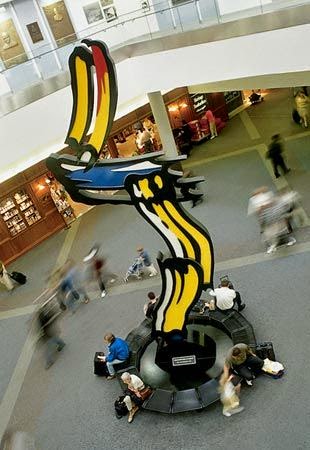
"Brushstrokes in Flight" by Roy Lichtenstein at CMH airport

If you want to skim through my long miserable travel story, and just get to the lab results and my reflections on all these goings-on, my feelings won’t be hurt.

Monday, May 25, 2015, I got out of bed around 5 AM after only 4 hours sleep in order to catch my early flight to Columbus via Dallas (DFW), so that I might arrive in Ohio (CMH) in time to spend some hours with a good friend over dinner.

All went well at the airport (breezed through security in 5 minutes) and with my first flight.

Little did I know that I would be spending time with news friends, my fellow travelers sitting on the tarmac for 3 hours the first time, and more than two hours the second time.

And I must have looked mighty strange during much of that hurrying up and waiting. Having somehow lost my N95 mask after the first flight, I wore the cloth eye mask that I had in my bag over my nose instead of using it for its true purpose of blocking out the light to allow sleep.

Torture by a million blows: 

First, after boarding the plane and a minute away from take off, comes the first 15 minute delay at the gate due to the rain that’s coming but not there yet, then another 30 minutes delay, and then more and more, then finally we are pushed out the gate as the ground crew are back in action now that the rain threat has passed, but when we get to our runway there are no longer any flight corridors to the north, so we wait and wait and wait again, then make the decision to make the long taxi to the other side of the airport for a take off on the still open longer southern route to our destination (FACT: DFW is bigger than the entire state of Rhode Island), only to wait again…. until we become too low on fuel to make it to Ohio, so back to the gate, where just before  things are looking as if we finally might get airborne, we next learn that our flight crew has just passed the “legal limit” of how long they can be at the controls, so we need a new pilot and first officer. More delays at deceptively optimistic 15-minute increments, until the final cancellation is not really announced, more just realized and we all march off the plane.

I am one of the lucky ones who left the long, long line at the unlucky gate and walked to the next open gate (a flight to NYC as I recall) where the helpful agent helped me grab one of the few remaining seats on the next flight out, originally scheduled for a departure about three and half hours after the first one.

I was OK with all this until the almost identical story started repeating itself on my second flight, right down to losing our crew as we were within minutes of departure.

Now I was starting to get panicky.

I was stuck at DFW. It was after 10PM and we had no crew. As a result of having no one in the cockpit, we, of course, had no air conditioning. No one could turn it on.

There weren’t even any flights available the next day that would get me to the clinic in time for an afternoon appointment. And I have my important IVIG infusion scheduled back in sunny California the day after. And the day after that, I’ll be off to Orlando, and the day after that, Chicago for ASCO. My dominoes were tightly lined up.

No clinical trial appointment at OSU would mean no more magic pills.

I was completely out of my ibrutinib, having stretched this clinic appointment to the maximum at 13 weeks. AND I had just read the ASCO abstract about increased relapses when we miss more than a week of pills. More on this critical subject later.

It got me thinking.

This cancer-controlled life is such a fragile construct and there are so many ways it can blow up. Let’s face it: Those of us with CLL that need treatment, especially in a clinical trial, especially in a clinical trial across the country, are high-maintenance and high-risk for something messing up.

Of course my dinner was canceled. And any food plans. No 7/24 vegan catering in Columbus.

But amazingly American Airlines did find a fresh first officer and about 45 minutes later, a new captain for my second flight.

That plane ride to Columbus ultimately left a little more than 8 hours later than planned and instead of arriving at 6:45 PM, I got in well after 2 AM. All the car rental stalls were closed. Got into bed at my friends’ house (without waking anyone up) around 3:15 AM and was up again at 6:45 AM for an 8 AM clinical appointment.

All of this with a lingering cold! And with less total sleep times in two days than total time on the tarmac.

But it all worked out.

And there were some unexpected surprises:

In Dallas, I was introduced to a wonderful 91-year-old women aviator, flight instructor and former WASP. At the request of her friends who discovered that we were on the same flight, I helped shepherd her through the same confusing mess that so many of were enduring. She was charming and full of great stories and she walked faster than I did.

When we arrived at CMH, she asked if I might help drive her home as we discovered she lived close to my friends’ home north of Columbus, so after some fumbling with the GPS in her new KIA parked in an offsite lot, I drove to my destination and she continued the less than 2 miles to her home.
At the clinic early the next morning, Dr. Byrd checked out my head cold and declared it was a head cold. No chest rattles or swollen nodes. No treatment.

My blood count was basically normal- borderline anemia, but all else was good including normal platelets. Blood chemistry was normal too, except for the usual low protein. That’s what happens when we don’t make immunoglobulins, so no surprise there

But I always seem to manage to find some cause for worry. My ALC (absolute lymphocyte count) was a very normal 2.48 but that is double what it has been over the last few years. It usually lingers around 1 or less. 

Why the jump up?

Could it be from my cold? You bet, but I still will be happier when I see that it is not the start of a trend.

(HAPPY UPDATE: ALC was 1.2 the next day back at my local infusion center at St. Jude Medical Center in Fullerton)

My small number of myelocytes probably also signifies nothing. You are not supposed to see any myelocytes in the peripheral blood

My LDH was just a tiny high too. 207 and normal tops out at 190. There are a million causes for that blip. Most are innocuous, but it can herald cancer resurgence when it climbs and climbs and climbs. Again it makes me more vigilant, but I know and I counsel others that the trend is your friend and will tell the tale, not one isolated and trivially elevated level.

Putting it all together (and more critical lab is pending) it probably doesn’t amount to a hill of beans, but I have been spoiled by a few years of mostly boring results.

One last sweet encounter to share:

As most of you know (probably to the point of annoyance at this point), I am vegan and eating on the road is always my personal challenge. Despite the heartening finds of lentil and kale/quinoa salads at DFW on Monday, unless I took some bold action, it looked like my food fare on the way home from breakfast until 10 PM when back in my own kitchen would be only the raw organic nuts, green teas, and the vegan cookies that usually accompany me in my carry-on bag for such contingencies.

CMH might have a fabulous Lichtenstein sculpture, but it is lacking in vegan cuisine. My connection in Phoenix is too tight to grab a snack even if there was an option.

So I sleepily waited at the James Cancer clinic after my appointment was done until the lovely Portia’s Café opened its doors at 11 AM, and then treated myself to a cab drive to to this Clintonville haven of delicious organic vegan and raw food. After a naturally sweet vegetal loose green tea, the tasty fortifying raw broccoli soup, a deeply satisfying gluten free raw hummus and sprout wrap and a to-die-for vegan chocolate “cheesecake”, my batteries were recharged. I wasn’t hungry any more.

The same cabby picked me.

Here’s the cool part of day two:

Magid, the cab driver, was born and grew up in Fez, Morocco and is a geography student. We talked and talked (some in English, some in French, none in Arabic) about his wonderful unique corner of the world that I have been lucky enough to visit twice. His wife has just joined him from Maroc.

He insisted on cooking me a vegetable tagine next time I am in town and I think I will take him up on the offer.

So despite all the delays and near panic and my dangerous lack of sleep (I wrote this on the first leg of my plane trip home), my travel adventure was full of some magical encounters, an on-time clinic visit and good news from Dr. Byrd.

I am flying home with 13 weeks of ibrutinib, and for my wife (SSSHHH!), two pounds of Tim Horton’s whole bean coffee and one squished apple fritter, treats for her that are woefully unavailable in southern California.

On a different note, please check out the CLL Society website today for the first of my monologues on therapy, this time on oral versus IV drugs. It’s a more nuanced decision than I thought when I first started researching the material for the post. The direct link is here and I would appreciate your feedback on this new format and content.

I think this is all working out.

My blog is reverting back to my personal story and where I postulate and pontificate however I want, sharing the good and bad.

The CLL Society website is evolving to be more about the facts and research news, their unpacking and contextualization in our effort to make them useful and accessible.

It is more effort to keep both going, but I believe they are both important in their own way.

What do think? Please let me know.


PS. We were sideswiped on our way out of the airport. Thankfully no one was hurt, but the rear and both door panels on the passenger side are going to need work. OY!

Labels: , , , , , , , , ,

Monday, December 1, 2014

Good News from OSU About my CLL ( Chronic Lymphocytic Leukemia)

It is no fun to travel on Thanksgiving weekend across the country to OSU, spending hours in busy airports full of long lines of irritable flyers, but I am know that I am one lucky patient and I am grateful for my good care and my good drugs, even if it means crossing 3 time zones and leaving sunny beachy California for cold and wet Columbus, Ohio.

When I started on my ibrutinib trial two and half years ago there was a definite buzz about this new oral med that might change everything.

Well the game has changed, or more accurately is changing, and it is only going to get better with new non-chemo combos and second and third generation kinase inhibitors and monoclonal antibodies  (mAbs) offering us more and more options.

We aren't there yet, but we are moving fast (but not fast enough for those of us who need answers now) in the direction of long term disease control. Cure is still elusive, but there is now an active area of research on curing CLL, sometime inconceivable a few years back.

I am an example of the early changes.

Before ibrutinib and idelalisib and ABT-199 and now the second generation kinase inhibitors and the new mAbs came along in trials, someone like me with a failed transplant and a clone of 17p deleted bad boys had fewer choices than a vegan at a Texas BBQ stand.

Now 30 months into my ibrutinib adventure, I have a boringly healthy blood chemistry, and a mundane CBC (complete blood count) with a normal numbers of my red blood cells, my neutrophils, my platelets, and an absolute lymphocyte count of only 1.04

If you dig deep enough with PCR or sensitive flow cytometry, I suspect my cancerous clone is still lurking in the less that one percent of my B cells that still carried the signs of being part of the nasty cancerous clone gang when checked three months ago at OSU.

But as I said much to happy about it. And many reasons to give thanks.

Now with my personal good results locked in for another three months until I return for my next OSU clinic visit, I am off to ASH 2014 to bring the broader good news and to push the CLL researchers and pharmaceutical industry no to take their foot off the gas until we have a cure for us all.

Let me know if you have any burning questions for the researchers at ASH.

Life is good.

Labels: , , , , , , , , ,